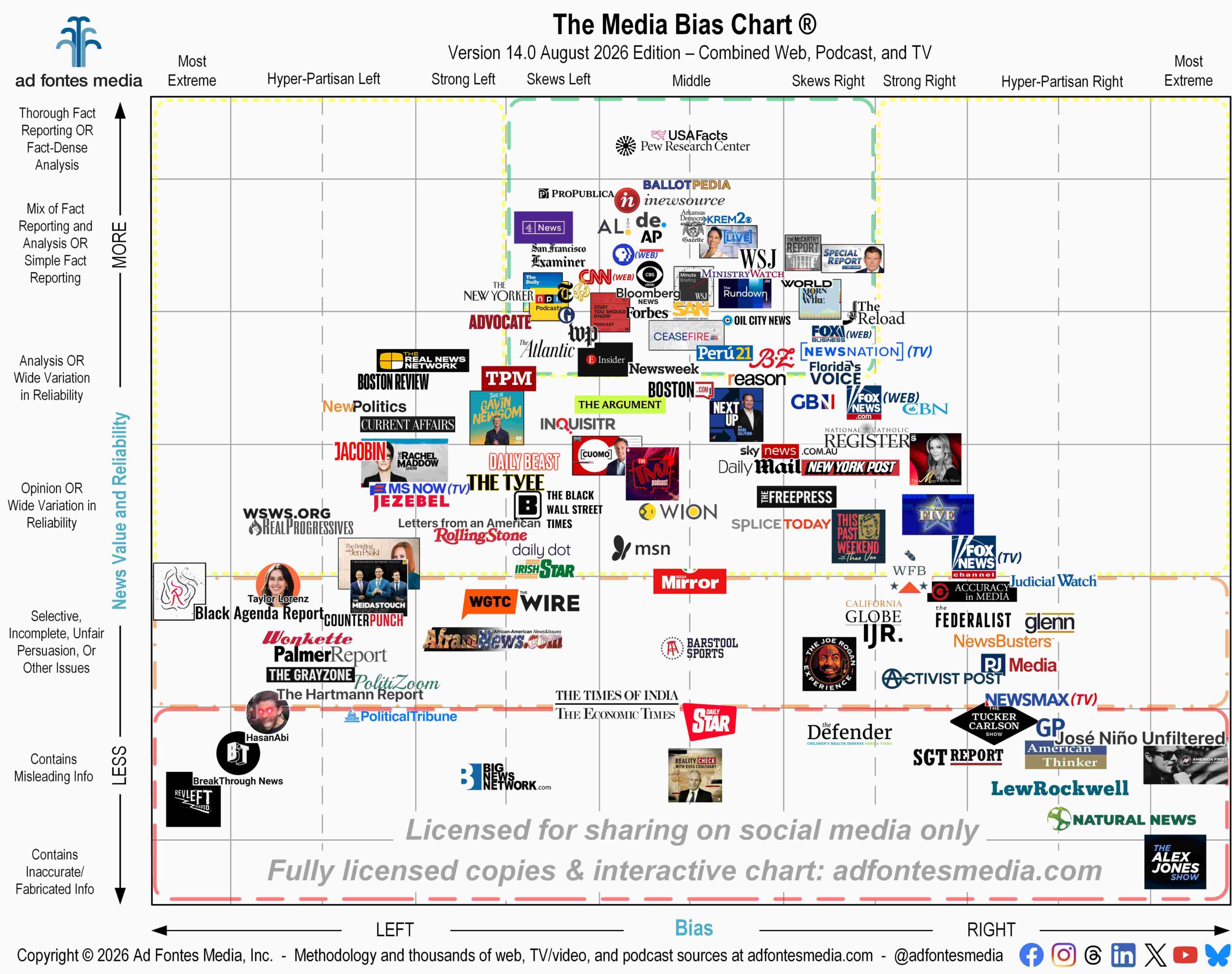
We have rated The Epoch Times since 2019. Our article sample as of the beginning of 2025 comprised over 300 human-rated articles selected as part of our normal sampling process for large publications. Its overall score at the beginning of 2025 was 16.20 for bias and 24.67 for reliability, which is “Strong Right” for bias and “Mixed Reliability: Opinion or Wide Variation” for reliability, which is a fairly low reliability score. We have just engaged in a paid audit by The Epoch Times upon their request, so we’d like to explain why we do audits in general, and how we are conducting this one.
We believe it is important to provide as much information as possible because since The Epoch Times has scored low for reliability historically, we anticipate outside observers will be appropriately skeptical of Ad Fontes Media’s motives, process, and potential conflicts of interest. Please note that as part of this audit, we invite the public to submit current and past articles from The Epoch Times for our review. More details on how to do so will be provided within this blog post.
Ad Fontes Media’s mission has always been “to rate all the news to positively transform the media landscape.” Since we first started in 2018, we have gone about rating as many news sources as possible using our own resources, meaning initially, we primarily used our own investment funding, and now, we primarily use our revenue.
The way we have prioritized what news sources to rate is to start with the biggest ones from any particular media type (website, TV/video, podcast/audio) and complete as many as possible, expanding to small and obscure sources. We scour the content landscape for news and news-like sources from the highest reliability to the lowest and from all gradients of left, center, and right. We’ve put our eyes on well over 20,000 websites and information sources and have some sort of rating on over 13,000 of them.
This means that the vast majority of the time, no publisher compensates us at all for our work to get a news source on the Media Bias Chart. That is by design; it wouldn’t be a very good business model for us to get all the content publishers to pay us to rate them. When we started and no one knew who we were, there was no reason a big and/or reliable news outlet would pay us to rate them. Most low-reliability and highly biased publishers don’t ever want us to rate them at all, let alone pay for it.
That’s why our business approach has been to use our own resources to rate as much as possible and then sell versions of the data sets we create to all the other stakeholders in news media, especially advertisers, researchers, educators, and individual news consumers. People need this information, so we can fund our work rating publishers by charging those who need to know about those news publishers.
However, as we’ve gotten more widely known, and our methodology has gained a reputation for being robust, thorough, and non-partisan, news publishers who score well have taken an interest in our ratings. They have found it useful to promote their high rating from an independent third party to their audiences and advertisers, so news publishers often reach out to see if we can provide services to them, like licensing our logo for promotional purposes, making sure they appear periodically on various versions of the chart, rating them if we haven’t rated them yet, auditing them (i.e., rating a bigger sample) to minimize their own bias, and providing training and feedback to their editorial teams.
Over the years we’ve provided these sorts of paid services to a handful (about two dozen) of these publishers who have reached out on an ad hoc basis, offering versions of our services based on their requests. Knowing that most publishers don’t need paid services, we’ve refined what we offer to publishers on our website, focusing mostly on what we can provide for free since we have already rated most of them, and specifying what we offer as paid services. The main free service we offer is an Ad Fontes Certified Highly Reliable Badge — any outlet we have rated that scores high enough on our reliability scale and low enough on our bias scale qualifies for it.
The main paid service we offer is an audit, which is paid because it requires our analysts to rate many extra content pieces in a large sample. In the past, we have audited large outlets such as Yahoo News, Law 360, Scripps, Newsweek, and Nexstar, and smaller ones such as KSL and Arkansas Democrat Gazette.
One big question we had to wrestle with early on is what might need to be different for audits of outlets with initial high-reliability scores versus ones with middle and low-reliability scores. Most of the publishers who want an audit already score high in our initial rating.
However, recently we have had more publishers with middle- to lower-reliability scores reach out because they legitimately want to improve their Ad Fontes rating and seek out our advice on how to do so. This sometimes happens because there is a change in leadership and editorial staff or at least a change in approach to what kind of content the outlet wants to produce.
When this started happening, we were gratified that in this way, our work really was starting to improve the media landscape! But it presented some challenges to navigate. For example, we didn’t want anyone to try to “game” our system. We were also cognizant that others might be critical and skeptical of both us and any news publishers seeking better ratings. Bluntly, we don’t want outside observers to think publishers can just pay us to get better ratings.
As a result, we created guidelines and requirements based on publishers’ initial reliability scores about what kind of services we provide for free and for payment. You can find those guidelines and requirements, which vary depending on whether a publisher scores above 36 for reliability, between 32-36, and below 32, on our Publisher Services page.
The Epoch Times reached out to us earlier this year (2025) because they have had significant changes in their leadership, editorial staff, and approach in the last few years, with some of the biggest changes occurring in November 2022 and more occurring in 2024. They had reached out to us in early 2024 inquiring about their score and what they could do to improve it. At the time, their overall reliability score was quite low, at 23.35, putting it in an “unreliable” category.
We gave them feedback, for free, in the form of data, notes, and meetings, on the scores of all the articles we had rated in our sample since 2019, which was over 200 articles. Articles scoring under 24 are weighted more heavily. The reliability categories on the Media Bias Chart indicate that articles between 16-23 are “Selective or Incomplete, or Unfair Persuasion.” Articles between 8-15 contain misleading information, and articles between 0-7 contain inaccurate or fabricated information.
It is part of our regular operating procedures to speak to any publishers who inquire about their scores and to provide individual article scores, notes, and feedback, particularly about low-scoring articles. We will also re-rate articles upon request from publishers if they think we scored an article incorrectly or if they have made a correction or retraction of an article. We do this in addition to routinely rating high-profile articles that have corrections or retractions on our own, and rating articles submitted by the public on a form on our site.
In cases where publishers indicate they would like to correct or retract numerous articles, we do our best to accommodate re-ratings for free. When we re-rate a low scoring article that was corrected well or fully retracted, with an acknowledgement of responsibility, the resulting score is higher than the original score but not as high as an accurate/reliable article would have been in the first place.
We can typically accommodate rating about a dozen articles for free before the cost becomes burdensome. If we perform a significant number of re-rates, we then prioritize that news source for additional sampling over the next several months. We do this to, again, avoid publishers gaming our system. That is, if they correct the articles we’ve “caught,” but continue to produce new low-reliability articles, we want to accurately capture that in our sample. We developed a rule for publisher audits that if a publisher has a lot of low-reliability articles they want us to re-rate, we would require an audit if that number were higher than two dozen.
The Epoch Times had a relatively large number of low-reliability articles in our existing sample, so we suggested an audit, subject to our extensive requirements for publishers with initial scores under 32. The main aspects of this audit are:
- We will advise upon retractions or corrections of all previous articles rated under 24 for reliability and re-rate the resulting output.
- Over the course of three months, we will rate (with our panels of human analysts) an additional sample of at least 900 articles which we will choose according to our own sampling methodology.
- The Epoch Times has published a public-facing statement about this audit on their site here: https://www.theepochtimes.com/article/analyzing-our-content-for-reliability-and-neutrality-5880331
- The footer of The Epoch Times website displays this statement along with a link to a form for the public to submit articles:

- We will rate all articles, whether old or new, that we receive from public submissions as part of this audit.
- This audit does not include EpochTV content nor NTD TV content. Existing ratings for content from those networks can be found on our Interactive Media Bias Chart®.
The Epoch Times’ overall score at the end of this three-month audit period will be calculated like all other news source scores are calculated: as a weighted average of all the article scores (including all the previously scored and newly scored ones). Low-reliability and highly biased articles are weighted more heavily in our calculations for all news sources. The Epoch Times has received no promise, expectation, or guarantee that their overall score will improve or that it will exceed any thresholds.
Through our prior analysis of The Epoch Times body of work over the years, we familiarized ourselves with the origins and ownership of the publication. Wikipedia’s page on The Epoch Times thoroughly documents its history, controversies, and instances of publishing low-reliability and highly biased (to the right) content.
The organization was founded by practitioners of the religious movement Falun Gong in 2000, and various outlets have reported on the actual and perceived influence of the leader of that religious organization on the publication’s editorial practices. The levels of influence and actual editorial practices appear to have varied over the years. The performing arts dance group Shen Yun is another high-profile project founded by and affiliated with the Falun Gong movement, and The New York Times has reported critically on the high volume of positive articles The Epoch Times has written about Shen Yun shows over the years, as well as other aspects of Shen Yun’s practices and the overall influence of the religious movement on the publication. The Epoch Times has responded to the New York Times’ reporting with articles of its own, refuting many of the NYT’s claims and implications.
Though Epoch Times and Shen Yun do not share common ownership, the lack of disclosure about common interests is potentially problematic for certain Epoch Times articles about Shen Yun, because journalism ethics standards require reasonable conflict-of-interest disclosures. We consider such disclosures or the lack thereof as a factor in reliability scoring on an article-by-article basis. Finally, much of The Epoch Times coverage over the years has focused on criticisms of the Chinese Communist Party, and its leadership has stated that a major part of the publication’s purpose is to report on abuses and misdeeds of the Chinese government.
Religious affiliations of news outlets do not in and of themselves inherently result in particular bias or reliability scores. We have rated many outlets affiliated with religious groups, including Catholic, Jewish, and Christian Science publications. The topical focus or “beat” of a news outlet also does not inherently result in particular bias or reliability scores. We have rated outlets that focus on niche topics such as climate change, social justice for prisoners, and public corruption. However, such affiliations and focusing on particular topics can certainly show up in the bias and reliability of article content, and we account for such bias and reliability issues through our standard content analysis methodology.
One purpose of requiring the public submission form on The Epoch Times’ website is to identify current and prior articles that other observers may find or have found problematic. We have also undertaken our own efforts to find such previously published articles, and we have found certain ones refuted by fact-checkers, such as dozens published by Science Feedback. To the extent those are corrected or retracted, we will also re-rate those and incorporate them into our sample.
Our analysts are necessarily aware, by virtue of the volume of Epoch Times articles we are currently rating, that we are undertaking a paid audit. As always, they have been instructed that they are to analyze the content of each article according to our content analysis methodology and rubric, and that they should be neither unduly lenient or unduly harsh on any particular publisher based on any relationship the publisher may have with Ad Fontes Media. Analyst objectivity is critical to our mission as outlined in our Stakeholder Statement regarding potential conflicts of interest.
We encourage members of the public, media researchers, fact-checkers, and journalists to submit any known or suspected low-reliability Epoch Times articles through our form here. And if you have any additional questions about this audit process, please feel free to reach out to us at info@adfontesmedia.com.

Vanessa Otero is a former patent attorney in the Denver, Colorado, area with a B.A. in English from UCLA and a J.D. from the University of Denver. She is the original creator of the Media Bias Chart (October 2016), and founded Ad Fontes Media in February of 2018 to fulfill the need revealed by the popularity of the chart — the need for a map to help people navigate the complex media landscape, and for comprehensive content analysis of media sources themselves. Vanessa regularly speaks on the topic of media bias and polarization to a variety of audiences.