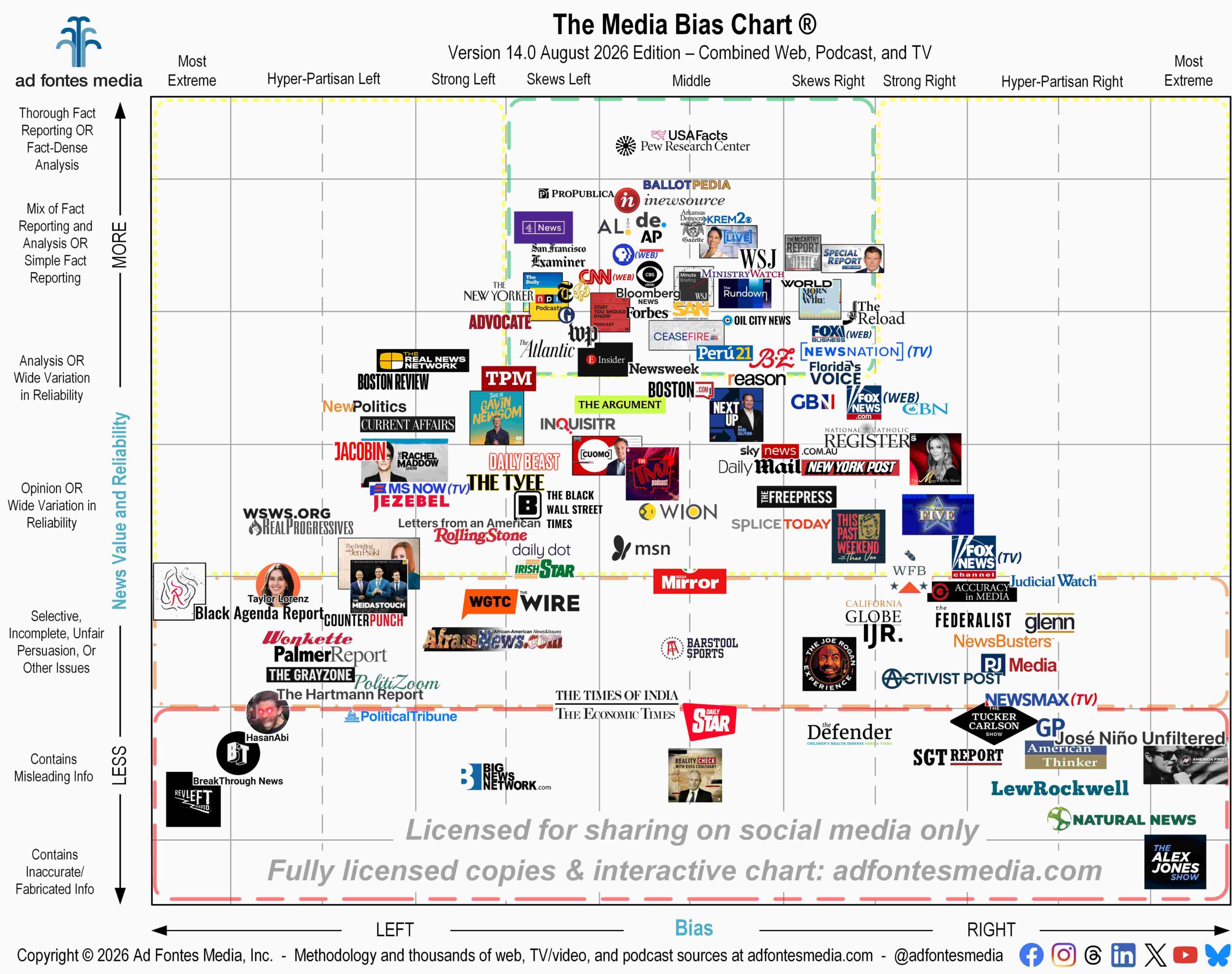
The editing of TV interviews has been under a lot of scrutiny in the past few years because of some high-profile cases related to U.S. politics: for example, a “60 Minutes” interview with presidential candidate and Vice President Kamala Harris in October 2024, and a “60 Minutes” interview with President Donald Trump earlier this month.
Following the recent broadcast of the “60 Minutes” Trump interview on Nov. 2, CBS News released a full, unedited version of the interview. Our team analyzed both the edited interview that was broadcast and the full interview. You can see the full interview, titled CBS Overdrive, on the November Media Bias Chart® for TV/video that we’re releasing today. More on that later. But first, some background:
For years, President Trump has complained about “60 Minutes.” He walked out of an interview for the show prior to the 2020 presidential election because he said the questions were unfair and biased. He refused an interview before the 2024 election.
His opponent, Harris, did sit for an interview, and after it was broadcast Trump argued that the interview was edited to make her look better, accusing CBS News of trying to protect her. CBS denied this claim, and plenty of analyses explain exactly the nature of the edit. He later filed a lawsuit against the company. CBS News’ parent company, Paramount, which needed approval from the Federal Communications Commission for a sale to Skydance Media, settled the lawsuit this summer, paying $16 million. The merger was later approved.
The lawsuit and merger led to other changes at CBS. “60 Minutes” executive producer Bill Owens resigned. New Paramount CEO David Ellison hired an “ombudsman” to investigate complaints about political bias, as required by the lawsuit settlement. Paramount purchased The Free Press website in October and named its founder, Bari Weiss, as the new editor-in-chief of CBS News.
And then came the new “60 Minutes” interview with President Trump. With all of this history, we thought it was important to rate both the broadcast interview and the full, unedited interview for bias and reliability, according to our content analysis methodology. Here’s what we found.
Our analysts gave both interviews a bias rating of “balanced.” Of course, the format of a media interview is questions from the journalist, in this case CBS News’ Norah O’Donnell, and answers from the interviewee, President Trump. We rate the content as spoken by both the interviewer and interviewee.
As leader of the Republican Party, it’s no surprise that Trump’s comments would represent the views of the political right. O’Donnell’s questions — and especially her follow-up questions, fact checks and comments in response to Trump’s answers — took a posture of challenging his statements and views (as opposed to other possible postures such as merely platforming them unchallenged, or actively cheerleading them). As a result, the overall bias of the content was rated as “balanced,” because O’Donnell’s challenges balanced Trump’s overt positions.
Analysts did note a difference in the reliability rating between the edited version of the interview and the unedited one. You can see the difference on this chart:
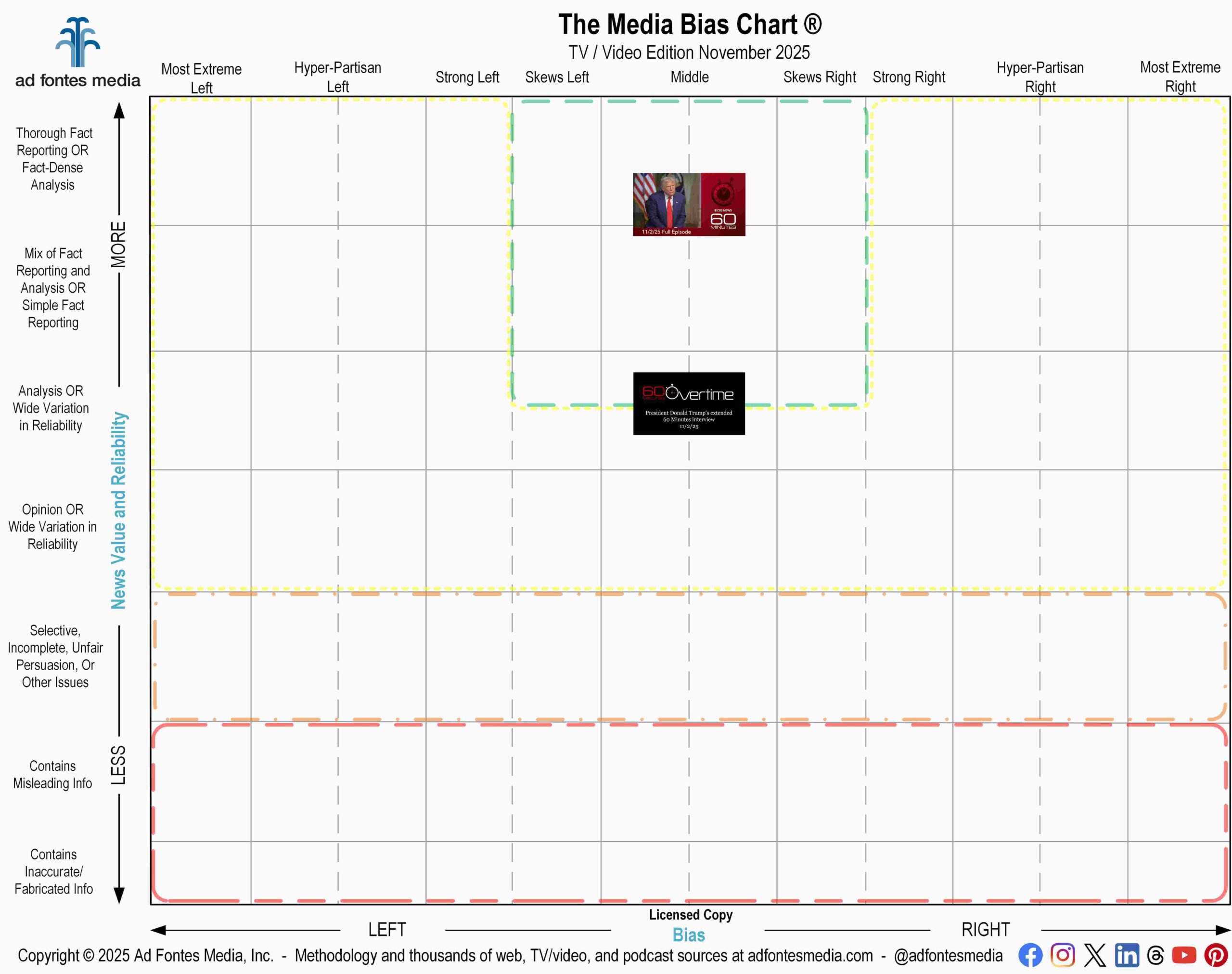
The full, unedited version of the interview (titled CBS Overtime) received a reliability rating of 36.33, placing it in the “analysis” category. The broadcast version of the interview earned a reliability rating of 49.33, in the category of “fact-dense analysis.” (It’s important to note that the Nov. 2 episode of “60 Minutes” rated by our team also included a short segment about the Guinness Book of World Records, but a majority of the episode’s content was Trump’s interview, and the bias and reliability notes from our analysts reflect that.)
Why the difference in reliability ratings? Our vertical rating rubric places the most fact-based content at the top, analysis and opinion in the middle, selective or incomplete content below that, and misleading or inaccurate content at the bottom. Our analysts found the edited version of the interview, the one included in the “60 Minutes” episode broadcast on Nov. 2, to contain more fact-based content than the full interview. Therefore, it received a higher reliability score.
The job of journalists in the specific format of interviews is to do more than ask questions. They must also be knowledgeable about the issues and push back when false or misleading statements are made. It’s difficult to fact check in real time, and our analysts noted several instances where President Trump made a false or misleading statement and O’Donnell did not challenge him. There were many instances, however, when she did, by asking follow-up questions and stating facts that contradict statements made by Trump.
The edited version of the interview broadcast on Nov. 2 contained more examples of journalistic effort by O’Donnell to clarify Trump’s comments and to present facts to the general public. This resulted in a higher reliability score. The unedited interview has more instances where O’Donnell did not fact check statements by Trump; this resulted in a lower reliability score.
As the comparison between the edited and unedited versions shows, a full unedited transcript can provide transparency into what was edited, but lack of editing, in and of itself, does not inherently result in news content being more reliable. Often, editing is necessary to make news content more reliable.
There are certainly instances where high-profile news outlets deceptively edit content; BBC was at the center of one such recent case (we’ll write more about that in another blog post).
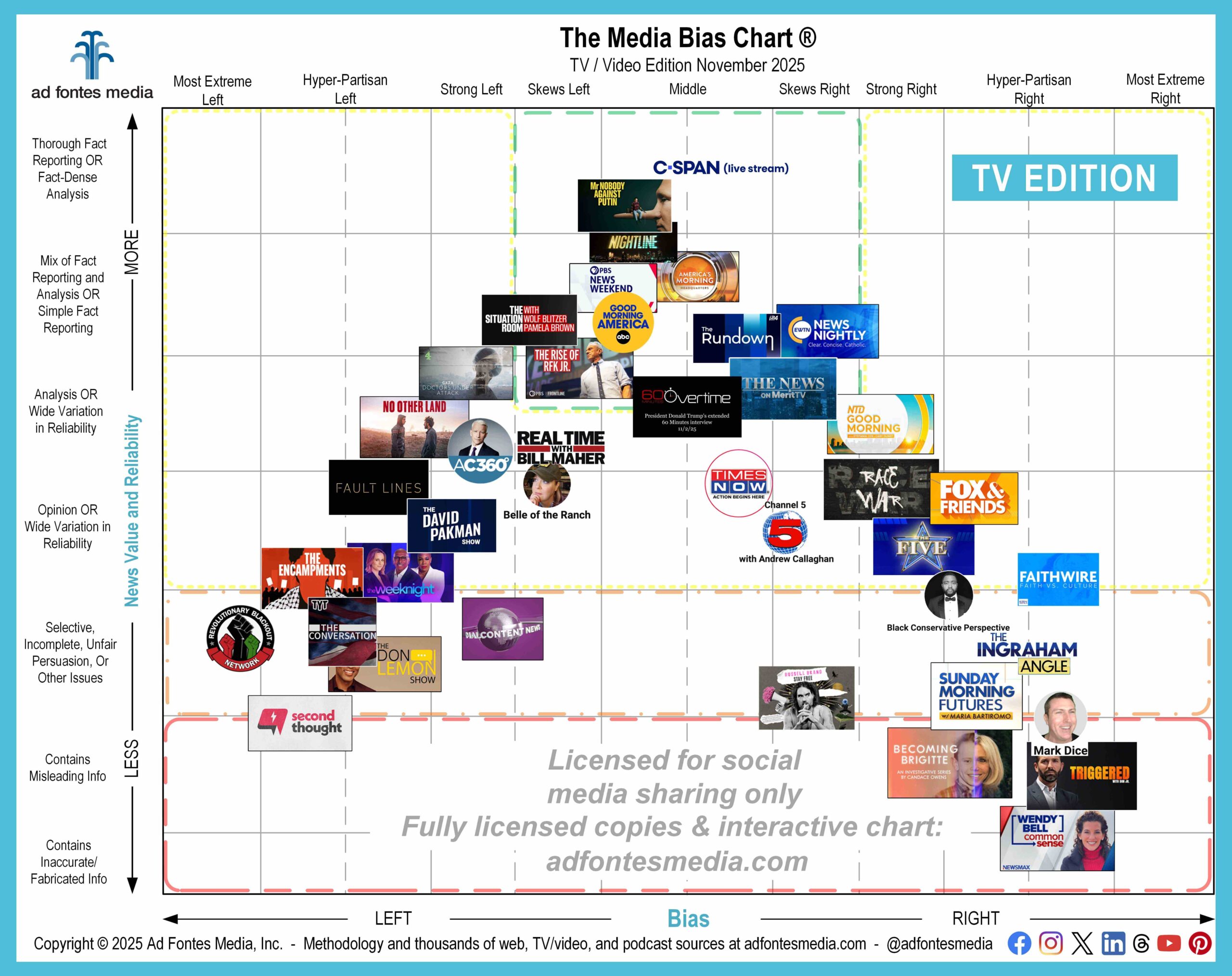
The CBS Overtime interview with Trump is one of 41 sources on the November Media Bias Chart® for TV/video. We’ve rated more than 820 shows in total, but it’s impossible to display them all in one image — the source logos overlap each other, and the result is a completely unreadable chart — so we choose a sample to feature each month. In order to make the logos as large and readable as possible, we have magnified a portion of the chart and removed portions around the edges that contain no sources.
Twelve shows appear in the green box of the November chart. Remember: Sources rated as minimally biased and fact-based are found within the green box. (More TV/video sources fall within the green box, and we’ll feature those on charts in the future.)
- 60 Minutes Overtime – November 2, 2025 – President Donald Trump’s extended 60 Minutes interview
- ABC: Good Morning America
- ABC: Nightline
- C-SPAN Live Stream
- CNN: The Situation Room
- EWTN: EWTN News Nightly
- i24: The Rundown
- Merit Street Media: The News on Merit TV
- Mr Nobody Against Putin
- PBS News Weekend
- PBS: Frontline: The Rise of RFK Jr.
- The Weather Channel: America’s Morning Headquarters
Eight sources appear on the Media Bias Chart® this month for the first time:
- 60 Minutes Overtime – November 2, 2025 – President Donald Trump’s extended 60 Minutes interview
- Mark Dice (YouTube)
- Merit Street Media: The News on Merit TV
- Mr Nobody Against Putin
- No Other Land
- PBS: Frontline: The Rise of RFK Jr.
- Race War
- The Encampments
Don’t see your favorite show on the November chart? You can look up ratings on all sources we’ve analyzed and create custom chart images using our free mobile app available for Apple and Android. You also can access the free version of the interactive chart on the website, which allows access to data on 250 of our top sources. Daily search limits apply.
To get expanded access, you’ll need a News Newbie or News Nerd subscription. Our subscribers can search all sources our team has fully rated (websites, podcasts and TV/video), with other added benefits! In all, our analysts have fully rated more than 4,470 sources, with commercial data on about 13,560 sources.
To keep up on all of our work, join our email list! We’ll send you news about the latest chart releases, Topic of the Week analyses, and more!
 Beth Heldebrandt is Director of Communications at Ad Fontes Media. She has more than 30 years of experience in the fields of journalism and public relations, and was an adjunct instructor of journalism for 17 years at Eastern Illinois University. Beth has a B.A. in journalism from Southern Illinois University-Carbondale and an M.A. in English from Eastern Illinois University. She’s a mom and grandma, and enjoys traveling, puzzles and reading.