The news from the Middle East is coming at us quickly as several countries are impacted by the U.S./Israel war with Iran. It’s important to be informed, but it can be difficult to know which sources of information you can trust. We can help.
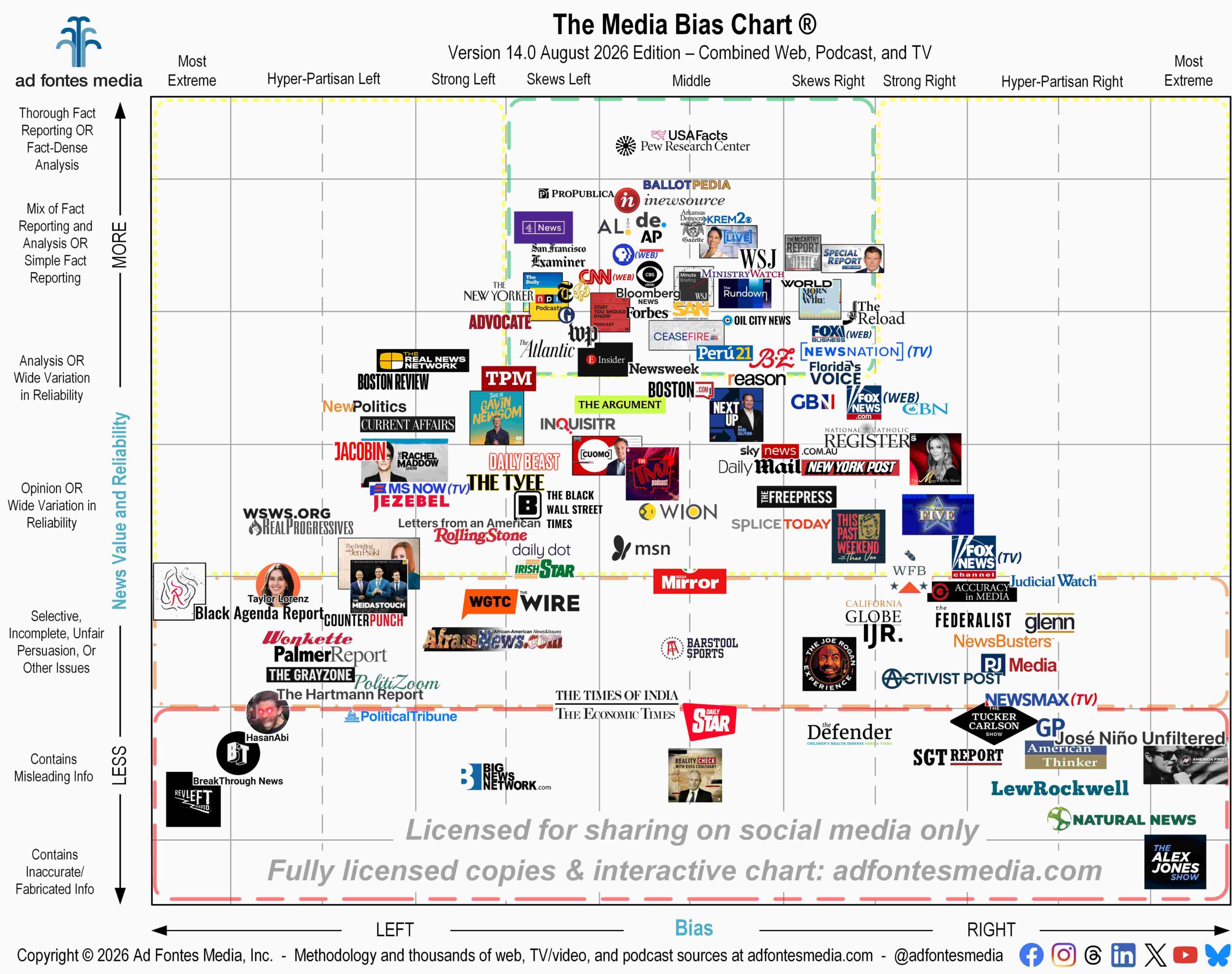
You can start your search for reliable sources of information on the March edition of the Media Bias Chart® for Web/Print that we’re releasing today. Sources in the green box (top middle) of the chart have been rated by our team to be minimally biased and to provide fact-based information.
In order to understand how different media sources are reporting on the war, we recommend choosing sources you haven’t read before from the top middle of the chart, from the left side, and from the right side. You will notice a difference in how the news is reported by comparing green-box sources with opinion sources on the left and right and with any sources that fall in the bottom portion of the chart.
For example, reporting from the AP (Associated Press), in the green box of this chart, will be different than reporting from PolitiZoom (bottom left of the chart), which is different than reporting from Daily Torch (bottom right). As news consumers, we can have a different understanding and viewpoint about U.S. military actions in the Middle East depending on which sources we rely on for information.
That’s why we suggest starting with sources in the green box of the chart for the most fact-based and minimally biased information. Here’s a list of the sources from the March chart that fall within the green box (many more web/print sources fall within the green box, and they will be included in future releases of the Media Bias Chart®):
- ADN America
- American Action Forum
- AP | Associated Press
- Army Times
- Barrett Media
- Bellingcat
- BorderReport
- CBS News (website)
- CBS Seattle KIRO 7
- Christianity Today
- CNN (website)
- EdSource
- FOX 11 LA KTTV
- Harper’s Magazine
- High Country News
- Jacksonville Journal-Courier
- KGUN 9 Tucson
- Lisbon Morning Journal
- Newsweek
- NPR (website)
- Pew Research Center
- ProPublica
- Quillette
- Semafor
- Sludge
- Straight Arrow News
- Texas Observer
- The Christian Post
- The Detroit News
- The Guardian
- The New York Times
- The Parnas Perspective
- The Reload
- TVO Today
- USAFacts
- Wall Street Journal
- Washington Post
- World News Group
- WV News
- Yellowhammer News
The March edition of the web-print chart features 125 of the 2,870 web/print sources our team has rated so far. You’ll notice that it contains a variety of sources of online information: local websites, national news organizations, Substacks, newsletters and wire services. We know it’s hard to read all of the source logos on the chart, so we’ve provided a list of the 125 sources here. (We’ll be back with charts that focus on podcasts and TV/video sources later this month).
Ten sources make their debut on this month’s chart. Sources in bold also fall within the green box:
- Arab News
- Daily Torch
- EdSource
- KGUN 9 Tucson
- Lisbon Morning Journal
- Status
- The Times
- TVO Today
- Washington Reporter
- Zeteo – Mehdi Hasan
Remember, we choose a selection of sources to include on each month’s chart because it’s impossible to put all of them in a single image. In order to make the logos as large and readable as possible, we have magnified a portion of the chart and removed portions around the edges that contain no sources.
If you don’t see your favorite source on the March chart, search for it on the Interactive Media Bias Chart® on the website. It’s free, but you can access only 250 sources, and there are limits in how many searches you can conduct per day.
To get expanded access, you’ll need a News Newbie or News Nerd subscription. Our subscribers can search all sources our team has fully rated (websites, podcasts and TV/video), with other added benefits!
You can also search all sources we’ve rated on our free mobile app for Android or Apple. Daily search limits apply.
Want to stay informed on all of our amazing work? Join our email list!
 Beth Heldebrandt is Director of Communications at Ad Fontes Media. She has more than 30 years of experience in the fields of journalism and public relations, and was an adjunct instructor of journalism for 17 years at Eastern Illinois University. Beth has a B.A. in journalism from Southern Illinois University-Carbondale and an M.A. in English from Eastern Illinois University. She’s a mom and grandma, and enjoys traveling, puzzles and reading.