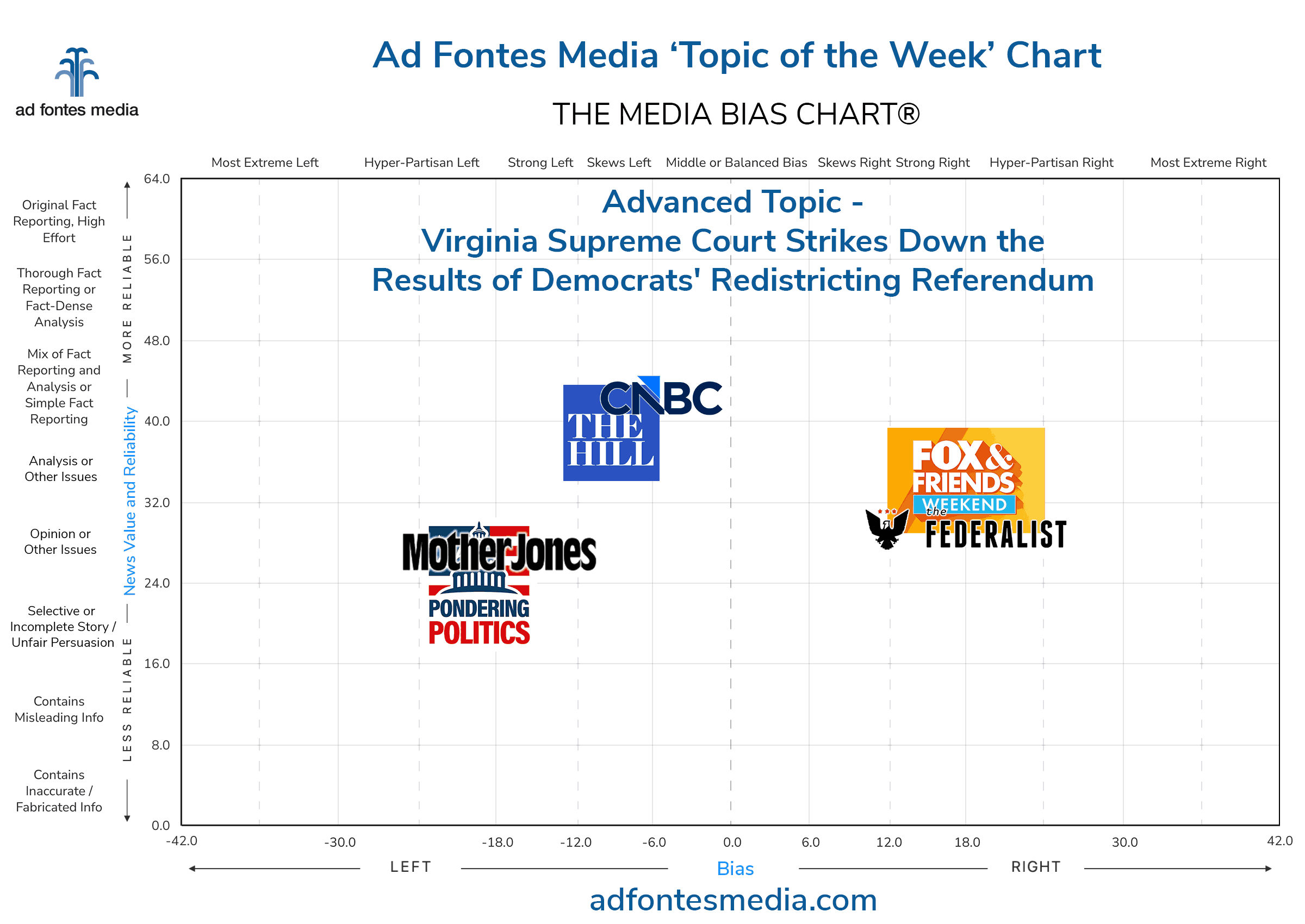
The Virginia Supreme Court last week struck down the state’s recently passed redistricting referendum, which could have resulted in four additional U.S. House seats for Democrats. This was the latest ruling related to nationwide efforts by both the Democratic and Republican parties to redraw congressional districts, as each accuses the other of unfair gerrymandering. Our analysts rated media coverage in our Topic of the Week.
CNBC gives an overview of the Virginia case in an article published on its website. It gives details about the court ruling and includes reaction from President Trump and from both Democratic and Republican party leaders. The article also looks at redistricting efforts in other states, including Tennessee. Analysts found the article to be a “mix of fact reporting and analysis” with a “middle/balanced” bias.
An article from The Hill takes a broader view, analyzing how the Virginia court decision will affect the overall attempts by Democrats and Republicans to gain congressional seats in November’s midterm elections. The article summarizes redistricting efforts across the U.S. and quotes political analysts who predict how many seats each party might gain, depending on the success of future redistricting plans and court appeals. Analysts found that the article includes much more left-leaning reaction to the court decision and categorized the article as “analysis” with a “skews left” bias.
In a video from the Fox News show “Fox and Friends Weekend” host Kevin Corke interviews Former Virginia Attorney General Jason Miyares, who calls the court ruling “a win for the rule of law” because the state did not follow the proper procedures when placing the redistricting referendum on the ballot. Miyares says Virginia has had nonpartisan redistricting in the past, and “let’s not change it.” Corke reads a social media post from online influencer Hasan Piker, who criticizes the court ruling. Corke describes the post as “inflammatory.” Miyares agrees and says Piker’s post is a “slippery slope towards excusing violence,” something he’s seen in the Democratic Party, “particularly with young liberals.” Analysts found that the video reinforces the Republican Party line and categorized it as “analysis” with a “strong right” bias.
Articles from Mother Jones and The Federalist were rated as “opinion.” The Federalist article focuses on the Virginia court decision: “The Supreme Court needed to explain what the definition of an ‘election’ is, so that Democrats could understand.” The article gives extensive background about the Virginia referendum and the court decision that overturned the results. The writer argues that “Early voting disenfranchises many voters who have voted without the full breadth of knowledge about what they are voting for.” The article says the Democrats tried to change the rules to benefit their party: “Democrats conveniently argue that the ‘election’ is a single day for purposes of gerrymandering, but in all other cases, it is 45 days long.” Analysts found that the article insults Democrats and shows a heavy partisan bias toward the GOP, assigning a bias rating of “strong right.”
The Mother Jones article gives an opposing view: “Republicans Don’t Need to Win Elections Anymore. They Just Need Their Judges.” The writer argues that the Virginia court decision “nullifies three million votes, boosting Trump’s effort to rig the midterms.” The article compares Democrats’ attempts to redistrict via voter-approved referendums to Republicans’ efforts: “Voters in red states have not been able to weigh in on any of the mid-decade gerrymanders passed by their legislatures.” The article concludes that “Democrats are bound by one set of rules while Republicans play by another” and accuses Republican-appointed judges of repeatedly putting their “collective thumb on the scale of elections to make sure their party prevails.” Analysts gave the article a bias rating of “strong left.”
The lowest-rated coverage from our content set came from a video on the Pondering Politics YouTube channel. The host, Jessiah Eberlin, begins by saying: “The Republican Party is now winning the gerrymandering war that they started under Donald Trump.” Eberlin reads an Axios article that summarizes the Virginia court decision, and he speculates that any appeal before the U.S. Supreme Court will lose because the court “has a vested ideological and partisan political interest in helping the Republicans, the party that put them in power in the first place.” Eberlin says that when push comes to shove, conservatives “will betray principle for political expedience.” He says that until gerrymandering is banned nationwide, Democrats must follow the Republicans’ lead: “We set ourselves up for failure by trying to do the right thing and Republicans never did. Now they’re exploiting their advantage and we’re tripping over ourselves… We need fighters in the Democratic party, not just at the federal level, but at the state level, too.” Analysts found that the video advocates for Democrats and insults conservatives while speculating without evidence. It was categorized as “unfair persuasion” with a “hyper-partisan left” bias.
If you’d like to follow along on our weekly Topic of the Week exercise, you can do so by visiting our website. New Topics of the Week are posted each Monday. Read the articles and watch the videos yourself, then come back on Wednesday to compare your scores with those of our analysts. Learn more here.
 Beth Heldebrandt is Director of Communications at Ad Fontes Media. She has more than 35 years of experience in the fields of journalism and public relations, and was an adjunct instructor of journalism for 17 years at Eastern Illinois University. Beth has a B.A. in journalism from Southern Illinois University-Carbondale and an M.A. in English from Eastern Illinois University. She’s a mom and grandma, and enjoys traveling, puzzles and reading.