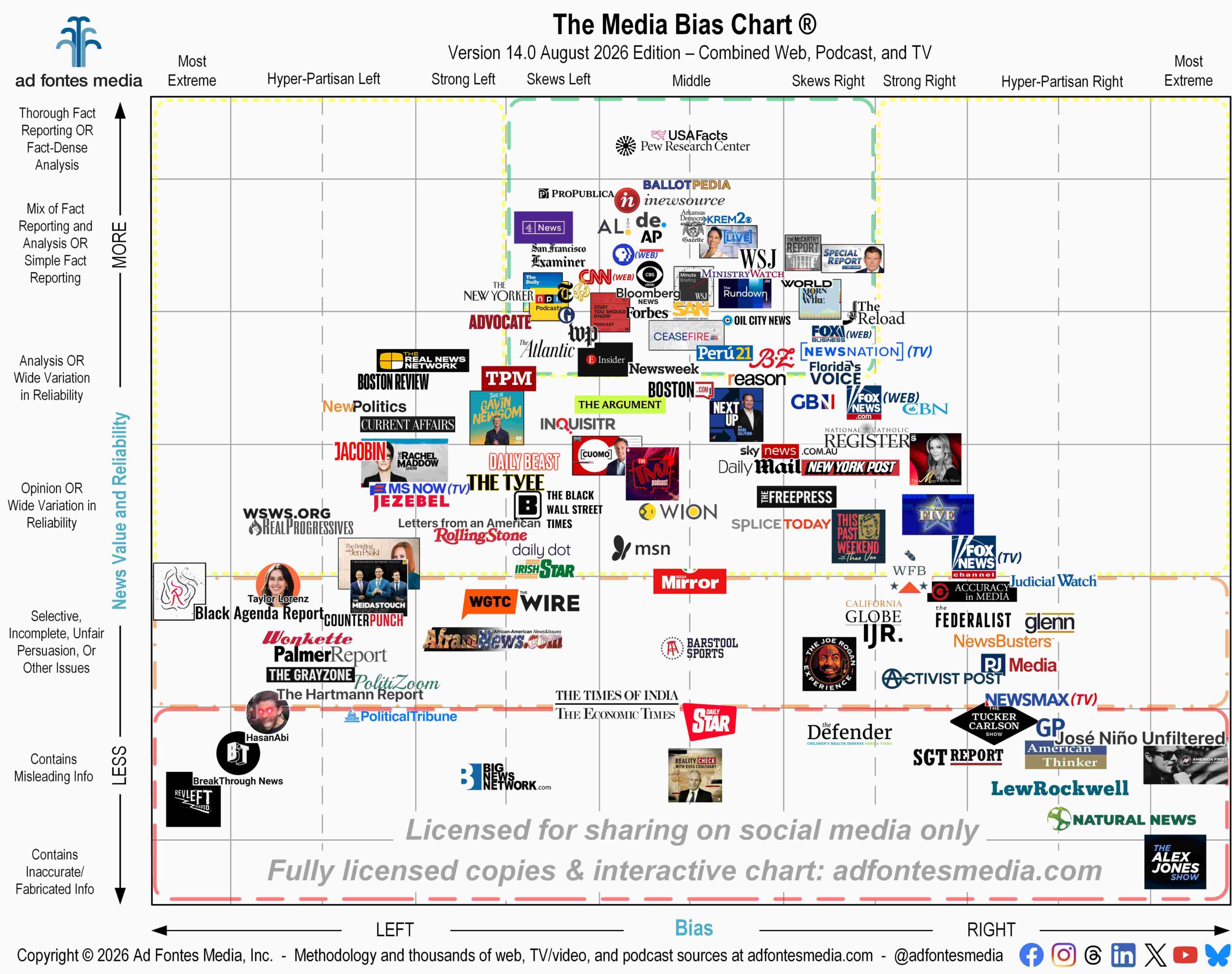
One of our analysts, Meisam Zamanabadi, was the subject of a recent story in an online publication called IranWire. Among other claims, the article accuses him of being an adviser to Mohammad Bagher Ghalibaf, Speaker of the Parliament in Iran. The article states that Zamanbadi coordinates the social media presence for Ghalibaf. Both of these claims are false.
We at Ad Fontes will not be assigning a numerical rating to the IranWire article for its bias and reliability because it is our policy not to rate content that mentions us since it creates an inherent conflict of interest. But since our primary work involves evaluating the veracity of media content, we believe it is our obligation to discuss why, in view of all the evidence available to us, both from Mr. Zamanabadi and separately from him, the Iran Wire claims are not credible. In the face of inaccurate information about both Mr. Zamanabadi and our company, it is important that we respond with accurate information.
First, some facts about Zamanabadi: He has been an analyst with Ad Fontes Media for five years and previously worked as a journalist in Iran, where he was born and raised. He is the founder and editor of the Tamashagar news agency and has worked in the field of journalism since 1996. He has covered approximately 60 news events worldwide and worked for several years as a TV host on popular talk shows such as “REDLINE.” He earned a master of arts degree in Media Management from the University of Tehran and moved to the U.S. to pursue a Ph.D. in Media Psychology at Fielding University, which he completed last year. He has lived in the U.S. for 10 years and his background in media and journalism provide skills that enhance his work as an analyst at Ad Fontes Media.
Mohammad Bagher Ghalibaf was the mayor of Tehran from 2005 to 2017. He is a former Islamic Revolutionary Guard Corps Brigadier General and has served as Speaker of the Parliament of Iran since 2020. In that capacity, he has been a lead negotiator in talks between Iran and the U.S. since the war began. Some media outlets have reported that Ghalibaf left his role on the negotiating team last week.
The IranWire article published on April 12 says Zamanabadi was a “pivotal advisor” to Ghalibaf when he was mayor. It says that Zamanabadi has continued to be an adviser during his time living in California over the past decade, and it accuses him of being behind recent social media posts made by Ghalibaf about the Iran war.
Zamanabadi denies both of these claims, and many others made in the article, and has formally requested a retraction of information published by IranWire. Following is Zamanabadi’s official statement as part of that letter.
“I categorically dispute the article’s central allegations. I have not served as a former or current adviser to Mohammad Bagher Ghalibaf, and I have never drafted, directed, or managed social-media messaging for him. I also dispute the article’s descriptions of my professional roles, institutional affiliations, and alleged financial relationships. Several of the sources cited in the article do not, on their face, substantiate the propositions for which they are used. Where the article makes historical, organizational, or personal assertions about me, I dispute those characterizations and request that they be corrected, removed, or clarified.”
Some basic scrutiny of the IranWire article reveals its credibility issues. Extraordinary claims require extraordinary proof, and while the article makes many bold assertions of facts about Zamanabadi, his father, and their relationship to Ghalibaf, it provides no actual evidence of these claims.
The headline asserts as a fact that Zamanabadi is behind Ghalibaf’s posts, but the only proof offered is speculation, such as saying that Zamanabadi’s resume contains the “exact elements observed in the English tweets, memes, hashtags, and emojis used by Mohammad Bagher Ghalibaf during the war with the United States.” This speculation supposes that only a person living in America would know how to use tweets, memes, hashtags, and emojis, which is a questionable premise in and of itself. But then the author makes the leap that not only is it definitely a U.S.-based person who is doing tweets (not, for example, Ghalibaf himself) – it is this specific person (Zamanabadi) because his resume shows familiarity with social media and its effects. This illogical leap is not evidence.
The article further uses passive voice claims like “it is said” that Zamanabadi played a key role in the selection of the current adviser to the Speaker of Parliament. This construction avoids pointing to any hint of something that could be verified. It could be verifiable if they described an unnamed source and described reasons why that source might be credible, but they did not do that here. It could be verifiable if they pointed to a document that said such a thing, but they did not do that here.
Furthermore, the claims that Zamanabadi’s name appeared in corruption investigations and that he was paid as a “Special Advisor to the Mayor of Tehran” are not corroborated because the articles linked as proof in the Farsi version do not mention Zamanabadi at all.
Just based on the content of the article alone, any reader could reasonably conclude that the assertions are unsupported. But in view of Zamanabadi’s subsequent denial, the reasonable conclusion is that these claims are false.
After the IranWire article was published, other media outlets in the U.S. picked up the story, and it was shared on social media. The Washington Free Beacon wrote about Zamanabadi and simultaneously criticized the work of Ad Fontes Media, but it did not include the false claims from the IranWire article. However, it juxtaposed Zamanabadi’s Iranian background with the criticism of Ad Fontes in a manner that casts general suspicions upon Zamanabadi and Ad Fontes. Though this article displays significant bias, it is written more accurately than the IranWire article and does not contain serious veracity issues.
HotAir (which is owned by Salem Media Group), has written about this twice, and both articles have severe veracity issues. In the first article published on April 14, it quotes from the IranWire story and claims without evidence that Zamanabadi is “living in luxury” while he “gets tens of thousands of dollars a month for doing this dirty work for the Iranian regime.” The article concludes: “… no doubt it is useful to have your propagandist embedded within the society you are working to bring down.”
HotAir’s April 21 article quotes extensively from the Free Beacon article. It says Zamanabadi manages the X account of the Iranian prime minister, a position that doesn’t exist. It calls Zamanabadi “an Iranian regime propagandist” who “sits right in the middle of this apparatus of influence” — that apparatus being Ad Fontes Media. The articles rely on the unproven claims from IranWire, along with posts and memes from X that simply reiterate the unproven claims.
Ironically, that second Hot Air article states right in the middle, “You can’t make things like this up,” though that appears to be what they did.
RedState, also owned by Salem Media Group, wrote a similar article on April 21.
Based on requests from Zamanabadi and Ad Fontes Media, the editors for the Hot Air and RedState articles attached an editor’s note to the top of each of their three articles that includes Zamanabadi’s statement denying the main claims. However, the original articles remain intact, and because they still contain all the previously existing falsehoods, they are likely to continue to deceive readers.
On April 27, IranWire posted another article about Zamanabadi based on the Free Beacon article that criticized our ratings. This new article misrepresents our methodology by claiming that Zamanabadi alone is responsible for our ratings. Zamanabadi is one of several dozen analysts on our staff, and every piece of content we rate is rated by a politically balanced panel of three of these analysts at a time. The Free Beacon objects to our rating of their outlet, especially as compared to other sources, but IranWire takes those opinions and asserts a false narrative that “Zamanabadi has manipulated assessments” and “Zamanabadi’s media activity charts show that he consistently evaluates news sources close to Democrats as more trustworthy than their conservative counterparts.”
Zamanabadi and Ad Fontes Media have requested retractions from these outlets and will pursue legal remedies as necessary.

Vanessa Otero is a former patent attorney in the Denver, Colorado, area with a B.A. in English from UCLA and a J.D. from the University of Denver. She is the original creator of the Media Bias Chart (October 2016), and founded Ad Fontes Media in February of 2018 to fulfill the need revealed by the popularity of the chart — the need for a map to help people navigate the complex media landscape, and for comprehensive content analysis of media sources themselves. Vanessa regularly speaks on the topic of media bias and polarization to a variety of audiences.