As negotiations to end the war in Iran continue, oil prices have spiked and fallen from day to day, resulting in a volatile stock market and affecting economies worldwide. Our analysts rated media coverage about the fluctuating oil prices in our Topic of the Week.
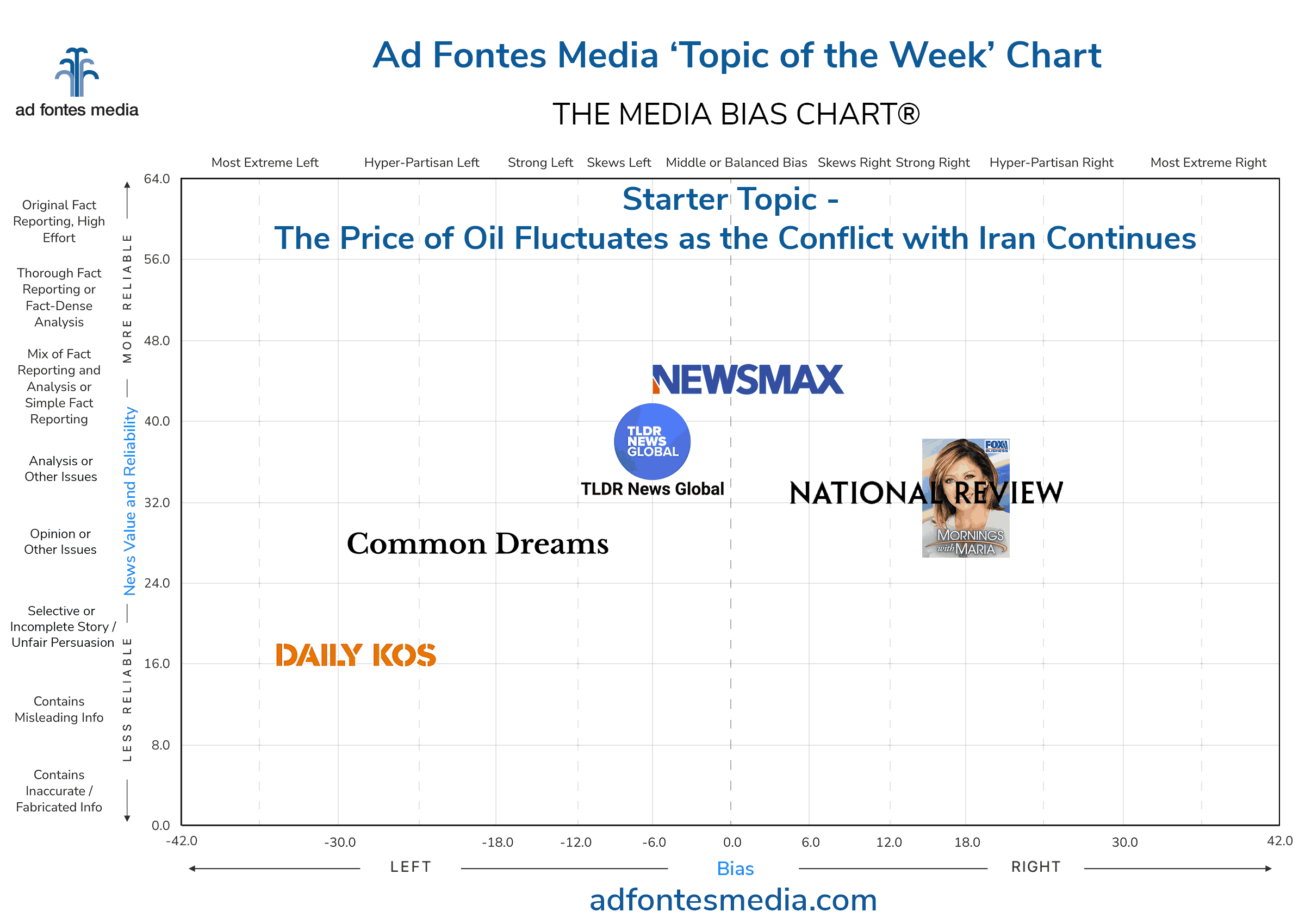
Analysts found the most fact-based and balanced coverage from our content set in an article by Associated Press that was published on the Newsmax website. The article, published on Sunday, focuses on oil prices rising after tankers were unable to pass through the Strait of Hormuz. The article details communications and military actions taken by both the U.S. and Iran in the preceding days, leading to “lifted hopes and dashed expectations involving the strait.” The article reports on the possible global financial impact if the strait remains closed long term. Analysts found the article to be a “mix of fact reporting and analysis” with a “middle/balanced” bias.
Scoring slightly lower was a video from the TLDR News Global YouTube) channel. The video, with the title “Why the Energy Crisis is About to Get Worse,” gives background about how the markets have reacted to the war thus far and then speculates about what will happen next. It presents graphs showing fluctuating energy prices and summarizes how countries around the world are adapting to the reduced oil supply. The video states that the market reaction to this “unprecedented energy crisis” “has been surprisingly muted if not outright optimistic” because many expect the conflict to be resolved soon. However, the narrator expresses caution: “There’s still an enormous gap between the two sides negotiating positions and a debilitating lack of trust,” he says. Analysts found the video to be “analysis” with a “middle/balanced” bias.
Two pieces of content analyzed by our team received similar scores of “analysis” with a “strong right” bias. An article from National Review focuses on the effects of the Iran war on Europe. The article’s premise is stated in the headline: “Europe Has Plenty of Oil, It Just Doesn’t Want to Use It.” The article argues that Europe has plenty of oil, but because it’s committed to reducing climate change, it has greatly reduced its own capacities to refine oil and are now more reliant on imports. “If Europe is facing a worsening energy crisis, it is largely self-inflicted, the inevitable consequence of a steadfast refusal to develop the fossil fuels that are within their territories,” it concludes.
In a video from the Fox Business show “Mornings With Maria Bartiromo,” the host plays clips from her interview with President Trump, who disputes previous administration comments that oil prices will still be high during midterm elections this fall. Bartiromo interviews Interior Secretary Doug Burgum about Trump’s decision to blockade ships headed to Iran and about predictions regarding oil prices this summer. Burgum voices support for Trump’s actions related to energy policy, including reduced “red tape” permits and the opening of a new natural gas pipeline near the New York Metro area. Analysts found that the video platforms Trump’s opinions and policies, with little pushback from the host on statements made by Burgum.
An article from Common Dreams looks at the impact of the Iran war on oil companies, as stated in the lead: “U.S. President Donald Trump’s unprovoked war of choice in Iran has been a goldmine for the fossil fuels industry, which is earning massive windfall profits thanks to the rise in the price of petroleum.” The article includes information from The Guardian, which “estimated that the 100 biggest oil and gas companies have collectively raked in an extra $30 million per hour” since the war began. The article quotes a climate watchdog group who says the current situation should be “a wakeup call to the world about the dangers of relying on fossil fuels.” Analysts found that the article advocates for climate change, rating it as “opinion” with a “hyper-partisan left” bias.
The lowest-rated reporting from our content set came from Daily Kos, which makes an accusation in its headline: “Trump Manipulates Oil Prices to Capture Huge Slice of the World’s Wealth.” The article says that the point of the Iran war “is to make oil prices go up and down, allowing insiders to grab unbelievable wealth. Then, they wake up and do it again the next day.” The article alleges that when Trump wants oil prices to go up, he “talks bad about Iran.” When he wants prices to go down, he boasts about “productive talks” with Iran. The article concludes: “Of course, many people will have died in Trump’s latest grift … But to a narcissist as far gone as Trump, other people cease to exist when they have no further place in Trump’s stream of consciousness.” Analysts noted the number of insults about Trump, as well as the unverified theory that he is intentionally manipulating markets, when rating the article as “unfair persuasion” with a “hyper-partisan left” bias.
If you’d like to follow along on our weekly Topic of the Week exercise, you can do so by visiting our website. New Topics of the Week are posted each Monday. Read the articles and watch the videos yourself, then come back on Wednesday to compare your scores with those of our analysts. Learn more here.
 Beth Heldebrandt is Director of Communications at Ad Fontes Media. She has more than 35 years of experience in the fields of journalism and public relations, and was an adjunct instructor of journalism for 17 years at Eastern Illinois University. Beth has a B.A. in journalism from Southern Illinois University-Carbondale and an M.A. in English from Eastern Illinois University. She’s a mom and grandma, and enjoys traveling, puzzles and reading.