Lots of “how to save journalism” thinkpieces often focus on one particular solution as the prescription for what ails the news business.
Some say they should rely more on subscriptions. But since most people don’t want to pay anything (this is crucial information that shouldn’t be behind a paywall!), they should provide a better advertising product. They should use first-party data, reduce ad blocking, and invest in programmatic yield optimization. And create non-news content like games and recipes – after all, advertisers are scared because of brand safety. If advertisers won’t buy anyway, maybe they should ditch the idea of even being a business, and the government should provide funding for news.
Or philanthropists should. But try not to have it be a billionaire who sticks their nose in the newsroom. They should block crawlers to their site and license their content to AI companies. Or not block them so they can appear in more AI searches. Maybe they should do live events. Or newsletters. Oh, and if you as an individual journalist want to make any money, you should go out on your own and build a podcast/newsletter/YouTube empire.
Everyone has a “this is the solution” take because they can think of a handful of examples where their suggested solution worked well for a particular “media” outlet. But there isn’t “one thing.” And as we’ll distinguish, running a successful “media” business and running a successful “journalism” business are not the same thing.
Let’s be clear on the actual societal problem the thinkpieces are trying to address: loss of specific types of journalists and the journalism they do, which are broadly these types:
- Investigative and/or public interest reporting for holding powerful individuals and institutions accountable (governments, large companies, the extremely wealthy, religious/academic/scientific institutions, etc.)
- On-the-ground disaster and world conflict reporting
- Local reporting about a community’s events and its people’s lives
- Stories about injustice and struggles that everyday people experience
- Other reporting on new information that is important to many people and would be difficult to obtain on their own.
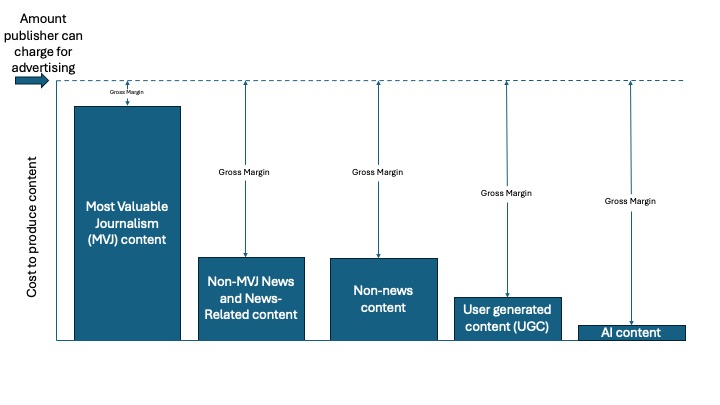
For shorthand, I’ll refer to this as the “Most Valuable Journalism,” or “MVJ.” It is the most expensive kind of content to create because it requires people going out into the world to gather and verify facts. The gross margin on MVJ, when selling subscriptions and/or advertising, is low, and often negative.
“Media” is a much broader term that often includes journalism (MVJ), but it really refers to all informational, educational, or entertainment content near which ads can be purchased. We’re not lacking for “media.” No one is lamenting that we don’t have enough podcasts or YouTube channels or internet pages generally.
“Media” content can be made up of these sub-types, in many combinations:
- Most Valuable Journalism (“MVJ” or just “journalism”)
- Non-MVJ news and news-related content (syndicated content, re-reporting, opinion and analysis, news aggregation)
- Non-news content (entertainment, sports)
- User-generated content (UGC)
- AI-generated content
Consider the fundamental reason there are so many business models associated with journalism: it’s because in journalism, you’re not selling the product directly, so your “business” is actually selling something else. If you make cars, you sell cars; if you make pizza, you sell pizza. When the product is information you have gathered, sure, some people will directly buy that in the form of subscriptions. But once the information is out there (and journalists do ultimately want the information out there) it costs very little for others to copy, share, or distribute it to others for free, despite the existence of intellectual property laws.
This dynamic inherently limits how much a new information gatherer can charge for any piece of information. The cost of production and the price someone will pay are untethered from each other. If someone buys a car or a piece of pizza, they can’t replicate that product and distribute it for free; the cost of production and the price are closely tied together.
Journalism, therefore, has to produce one product but sell related, but different products. Often, that is advertising; they sell the attention they have gathered. But competition for human attention is especially stiff because it’s finite, and units of such attention across other types of “media” can all be sold for similar prices.
The overall amount of MVJ has declined in the last 20-some years, evidenced by the decline of the number of journalism jobs that produce it.
However, the overall volume of other media content – particularly “non-MVJ news and news-related content” and “non-news content” – has drastically increased over that time. The cost to do journalism (MVJ) has remained relatively high, but the costs to both publish and distribute any type of content have come down drastically because of technology. Therefore, the gross margin when selling subscriptions and/or advertising on non-MVJ and non-news content can be much better than the gross margin for MVJ.
Obviously, everything but MVJ content has increased across the internet; think of how much user-generated content there is on social media and YouTube (near-zero cost for the advertising platform to create – makes for great margins!). Think of how many podcasts, sports, games, and entertainment options there are.
But there is also more non-MVJ news and news-related content on journalism publishers’ properties, too.
One kind of non-MVJ news is re-reporting, either by straight syndication (reprinting) of others’ content or by rewriting information another outlet’s journalist reported on first. A good version of re-reporting would entail an additional angle and independent verification by the writer, but that’s maybe 1/10 of the original work. A less rigorous version would be a straight rewrite of another article that requires no more than clicking around on the internet for background info, and that’s maybe 1/50 of the original work. The worst version would just be straight plagiarism, or, more common these days, an AI rewrite (still plagiarism, but with Exciting New Technology). That’s 1/1000 of the work. The relationship between effort and gross margin again runs in parallel. Less work, more margin.
Then there’s the news-related content on journalism publishers. There’s the opinion columns, which garner the same units of attention from the reader. They cost the time and effort of the writer and editor, but they’re less expensive to produce than an original news report. On TV, there are the cable broadcast shows that are an hour long and have four topics and 35 pundits arguing about them; it’s somewhat expensive to have all those guests and that fancy studio and cameras, but far less than the cost of the 30-minute nightly news broadcast that had 12 stories of 2-3 minutes, each of which took all day to produce and/or involved reporters on the ground.
The gross margin differences between MVJ and non-MVJ content, between MVJ and news-related content, and between MVJ and non-news content create obvious incentives for anyone remotely business-minded. Whether you are a lone individual or a large, long-established news outlet, if you want your advertising business to be profitable, there are two levers to pull: one, attract more advertising, and two, reduce your costs.
An individual or very small crew can create a successful “media” company out of purely non-MVJ news-related or non-news content and compete with MVJ producers for attention and advertiser dollars. That’s why newsletters and podcasters and YouTubers are economically viable – often more so than a journalism job at a major outlet. And that’s why large journalism organizations, when under profit pressure, will decrease their ratios of journalism to all other types of content.
In view of the market incentives, it’s amazing there’s any journalism left at all. But it still exists because of a baseline need (both individual and societal) for important new information. This means there will always be a decent-sized baseline market for the attention, and therefore, advertising space, on journalism. And there will always be some people and organizations who will do this work as long as they can survive—those willing to do it for the love and the mission, foregoing more lucrative careers or businesses. Therefore, there are news outlets that remain more like “News Outlet 1” than “News Outlet 2” below: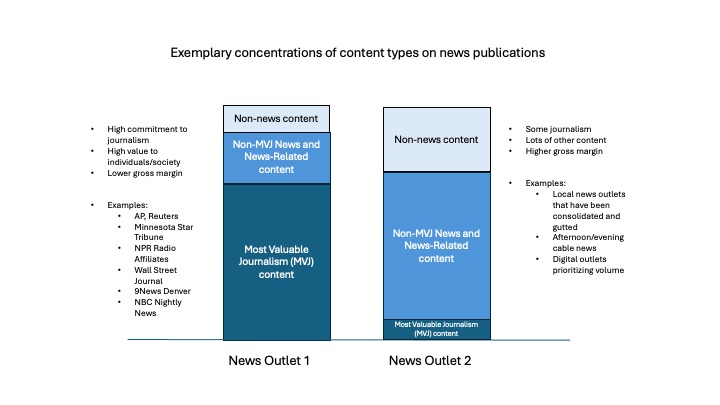 It takes a lot of commitment for a journalism outlet to maintain a high absolute volume and relative percentage of journalism content. And if we value journalism, we should want more publishers to be more like News Outlet 1 (a journalism business) than News Outlet 2 (a media business). Existing market incentives make the opposite true. The individual subscribers of the journalism businesses recognize their value, but they are not enough to make them sustainable. However, if the biggest journalism and media market participants – advertisers and tech companies – did a better job of acknowledging and rewarding that value, they could make them much more sustainable.
We must deal with the role of advertising and technology companies specifically. Because the fundamental work of creating journalism has remained relatively consistent for decades, but the various business models to fund their journalism have changed drastically any time there has been a shift in either the advertising or technology fields.
The thousands of outlets in the news graveyard are evidence of exactly how great the challenge of running a journalism business is. Yet others have somehow figured out how to be viable and even lucrative. Bloomberg, The Wall Street Journal, and the Financial Times are able to subsidize important original reporting because of their financial services subscriber and advertiser bases. The New York Times has figured out a winning combination of national reader subscriptions, advertising, and other revenue diversification (and notably, has invested a lot in expanding their newsroom). AP and Reuters have long funded their journalism via content licensing to other outlets and have expanded into advertising in recent years. Relatively new Semafor seems to have figured out a good advertising and events combination, and The Philadelphia Inquirer worked its way back to local subscription and advertising profitability after a philanthropic rescue. For nearly all successful outlets, advertising does have to be some portion of the revenue to make the math work.
The scope of an outlet’s coverage puts an upper limit on its profitability; for example, a small local paper or social-justice beat publication is not going to have the same revenue potential as a national or financial industry publication, but there are examples of each that work. If we collectively want those local and niche coverage to exist as well, individuals, advertisers, and tech companies need to recognize and reward their value as well, even if it is a bit more effort.
The immense business challenges of creating journalism negatively affect us all. Less MVJ means less accountability and more corruption and injustice. Without the determined work of local journalist Julie Brown of the Miami Herald back in 2018, for example, Jeffrey Epstein would never have been convicted of his crimes. Think of all the subsequent media content that one piece of MVJ enabled.
Journalism’s available business models are uniquely tied to both the advertising and tech industries. No business owes a handout to any news outlet, and news outlets aren’t asking for one. But a healthy press enables a healthy societal and economic environment, and therefore, it is in the interest of advertising and tech businesses to make it less difficult for the journalism businesses among us to thrive. This primarily involves two things:
- Find opportunities where your business interests align with journalism’s business interests: Most commonly, for advertisers, that means advertising around most-valuable journalism. Its inherent quality has proven to be a superior advertising environment over other types of content, so give it full consideration as such. For large tech companies (e.g., Google, Meta, Apple, OpenAI, Anthropic), journalism forms valuable infrastructure, so aligning business interests often means compensating news outlets for using their content.
- Refrain from actively disadvantaging or exploiting journalism’s work product: For advertisers, this means ditching news blocking, and for tech companies, it means not stealing their content or changing monetization models overnight.
It’s OK that there is not “one thing” that will “save journalism.” Those who choose to be in the journalism business will continue to do what it takes, and there are a handful of thoughtful things that the rest of us can do to make that work easier. And we should do them with all our might.

Vanessa Otero is a former patent attorney in the Denver, Colorado, area with a B.A. in English from UCLA and a J.D. from the University of Denver. She is the original creator of the Media Bias Chart (October 2016), and founded Ad Fontes Media in February of 2018 to fulfill the need revealed by the popularity of the chart — the need for a map to help people navigate the complex media landscape, and for comprehensive content analysis of media sources themselves. Vanessa regularly speaks on the topic of media bias and polarization to a variety of audiences.