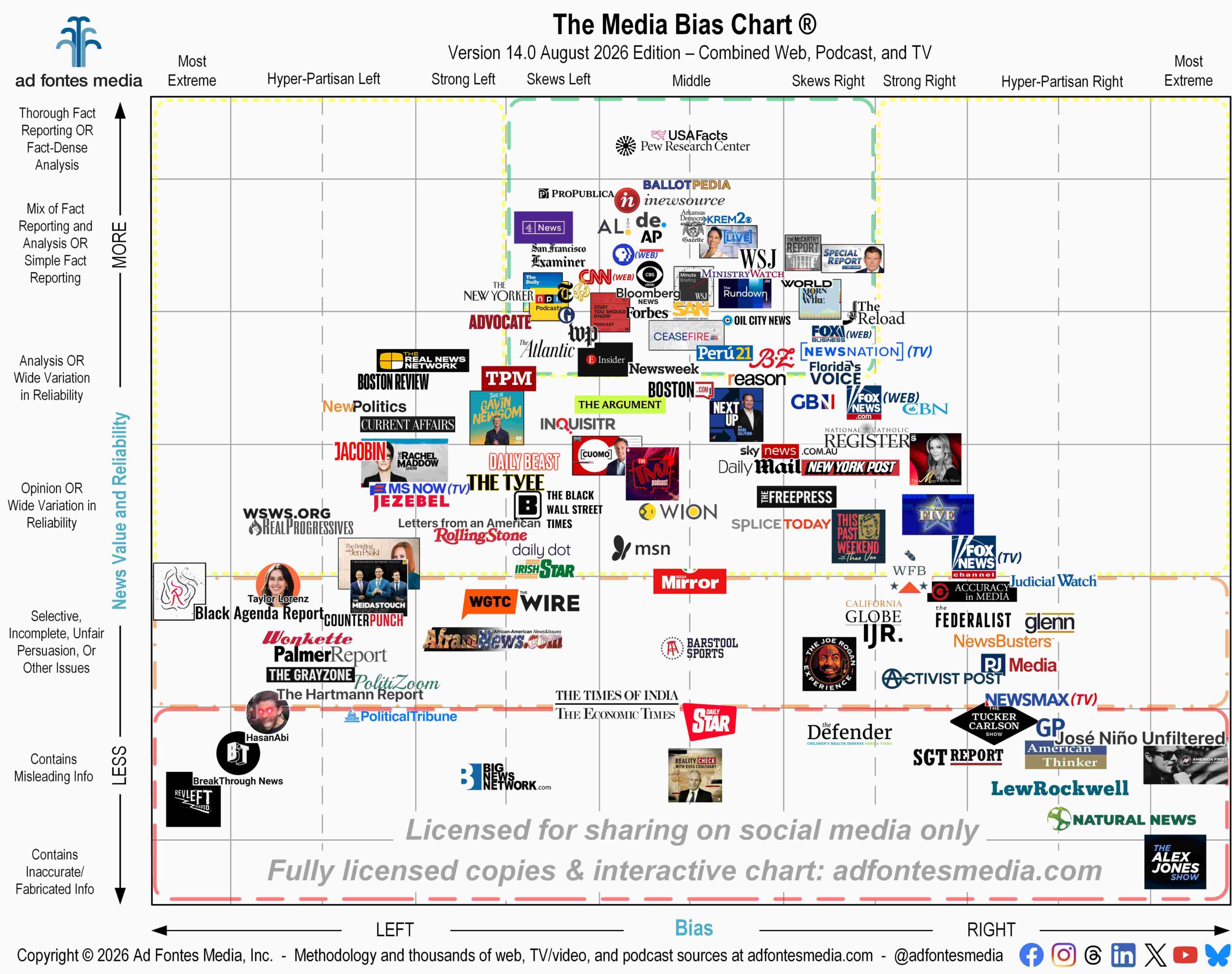
Last week Dr. Anthony Fauci, former director of the National Institute of Allergy and Infectious Diseases (NIAID), appeared at a hearing about the COVID-19 pandemic before the Senate Committee on Homeland Security and Governmental Affairs. Fauci invoked his Fifth Amendment right more than a hundred times, refusing to answer questions. Our analysts rated media coverage about the hearing and about the recent release of Fauci’s private diaries in our Topic of the Week.
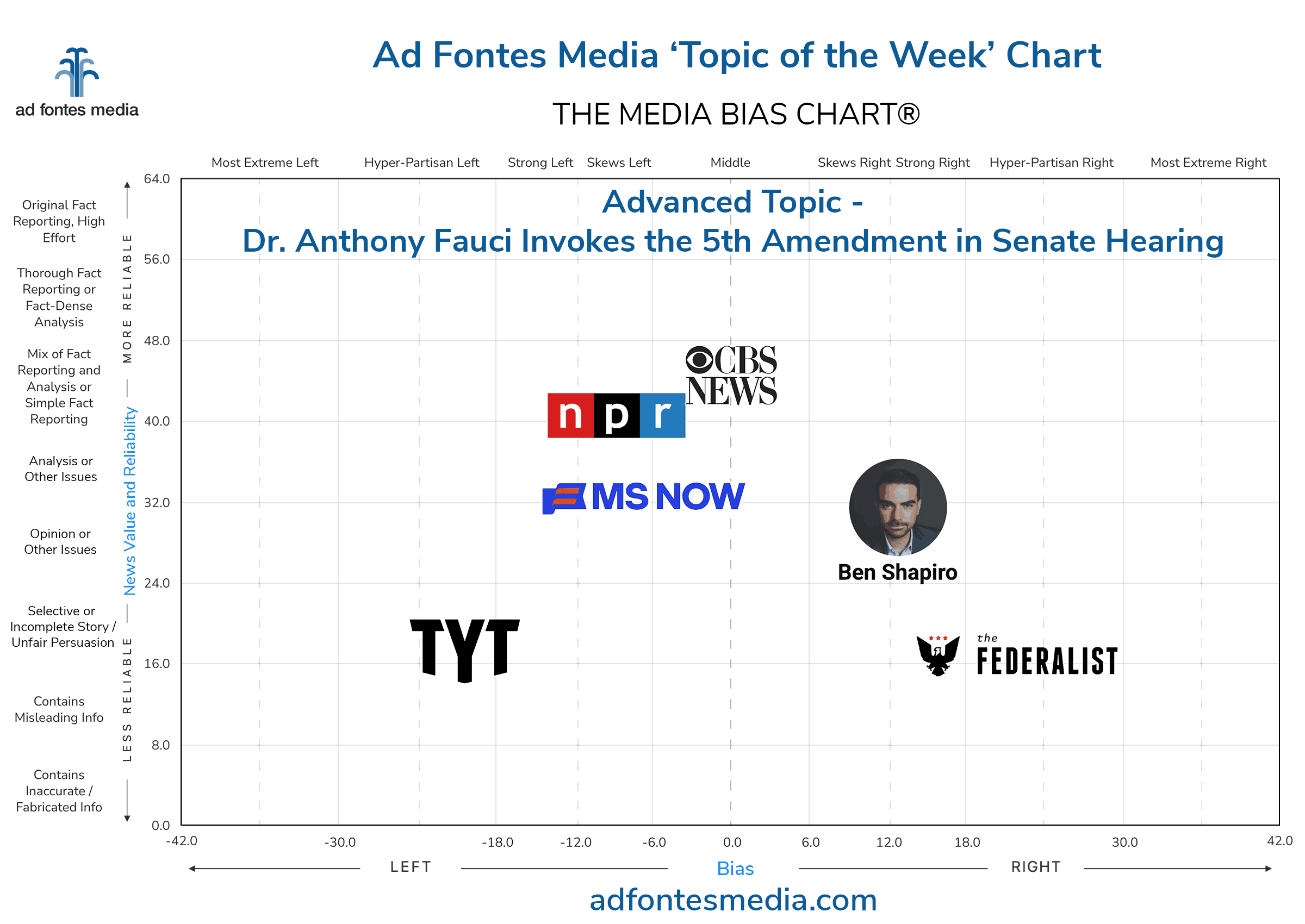
CBS News published an article about comments by Sen. Rand Paul, who chaired the hearing. Paul said there was a “very real chance” that Fauci would be held in contempt for refusing to answer the committee’s questions (on Aug. 6, the committee passed a vote to hold Fauci in contempt). The article gives background about the relationship between Fauci and Paul, who has accused Fauci of lying about the origins of COVID-19. Analysts found the article to be “simple fact reporting” with no bias.
An article from NPR focuses on the possible negative effects of the hearing on public health. The article recounts how the pandemic was handled by public health officials and how Americans’ trust in them has changed during President Biden’s and President Trump’s terms. It quotes officials who say the number of students wishing to study public health has declined, and that public health officials may be intimidated by the hearing and be less willing to provide necessary information to lawmakers and officials in the future. The article received a reliability rating of “mix of fact reporting and analysis” with a “skews left” bias, because much of the information presented affirms Fauci’s stance on the pandemic.
An opinion article from the MS NOW website supports Fauci’s handling of the pandemic, stating that he often changed his mind based on new evidence, and “that’s what scientists are supposed to do.” Writer Ann Keller says she is disappointed but not surprised that Republican senators tried to “take down” Dr. Fauci during the hearing. She refers to AIDS and climate science as examples of how science can change as new evidence is discovered and understood. “Monday morning quarterbacking is easy. Try advising countries on how to manage a growing pandemic while the ground is moving beneath your feet.” Keller worries that in the future public health officials will be less forthcoming with important information because of the way Fauci has been treated. Keller expresses support and sympathy for Fauci, leading analysts to rate the article as “analysis” with a “skews left” bias.
A video on the Ben Shapiro YouTube channel begins with this headline: “Fauci Crumbles Under Questioning.” Shapiro says it was clear early in the pandemic that “Anthony Fauci was actually driven by ego” rather than data. He refers to Fauci’s private diaries, which were released by Sen. Paul, and says they’re filled with “self-congratulatory references,” but they also admit that he knew there was a chance the COVID-19 virus actually started in a lab but lied about it repeatedly. He describes the Senate hearing and handling of the pandemic as the “unmasking of Fauci” and the “failure of the scientific establishment to police its own.” This leads, he says, to people not trusting health experts and believing whatever they hear or read on social media. Shapiro proclaims that the COVID-19 virus came from a lab in China, who “unleashed it on the world”; that the World Health Organization (WHO) knew it; and that Fauci covered for WHO. Because of Shapiro’s insults of Fauci (he calls him an “obnoxious tool bag”) and his beliefs about the handling of the pandemic, analysts rated the video as “opinion” with a “strong right” bias.
In a video from “The Young Turks with Cenk Uygur and Ana Kasparian”, the hosts state that they had trust in Fauci and our institutions during the pandemic but now have doubts and mistrust about both. They analyze Fauci’s diaries, which Kasparian says are “beyond infuriating” and says he “should be prosecuted” for what they contain. Kasparian says the diaries prove the virus was created in a lab, not transmitted from animals to humans in a wet market, and Fauci knew it but lied about it. Uygur says Fauci “squashed” scientists who believed the virus was man-made and not naturally occurring. The hosts encourage people to always question authorities and experts no matter which side of the political spectrum you’re on, although it’s important to remember that Trump was president during the pandemic, and “the way that he was communicating about the virus did not inspire much confidence.” Kasparian mocks Fauci for his “ego” and the “self-aggrandizement” in his diaries. The hosts compare Fauci’s diaries with his public comments. “We were lied to about everything,” Kasparian says. Uygur accuses Fauci of “using the media to intimidate and bully the rest of us into compliance.” Both hosts criticize the U.S. funding of gain-of-function research in general. Analysts rated the video as “selective or incomplete” for choosing passages from Fauci’s diaries only to mock and discredit him, with a “hyper-partisan left” bias.
An article by The Federalist uses the “Fauci debacle” to criticize the entire Democratic Party. Writer Chris Bray says “Democrats always lie the same way” and people become immune to it, except for Democrats, who were “born to be fooled.” Bray uses “shameless couple” Bill and Hillary Clinton as examples, stating that they “developed a set of reliable techniques for the management of uncomfortable questions”: “Delay, delay, delay / dismiss the scandal as old news.” Bray criticizes Sen. Maggie Hassan for “manufacturing a fake crisis as a pathetic distraction” when she posted that the U.S. should be worried about measles and cyclospora outbreaks rather than questioning Dr. Fauci about COVID-19. He calls Sen. Dick Durbin an “old prostitute” and accuses him of discrediting the Senate hearing in the name of “conspiracy theories.” “That phrase has become one of our clearest signals that you’re in the presence of truth,” Bray says. The article encourages readers to understand these tactics by Democrats “and then to learn to hate them as much as they deserve to be hated.” Analysts found the writing to be “sarcastic, condescending and contemptuous of Democrats.” The article was categorized as “selective/unfair persuasion” with a “hyper-partisan right” bias.
Follow along with our weekly Topic of the Week exercise by visiting our website. New Topics of the Week are posted each Monday. Read the articles and watch the videos yourself, then come back on Wednesday to compare your scores with our analysts. Learn more here.
 Beth Heldebrandt is Director of Communications at Ad Fontes Media. She has more than 35 years of experience in the fields of journalism and public relations, and was an adjunct instructor of journalism for 17 years at Eastern Illinois University. Beth has a B.A. in journalism from Southern Illinois University-Carbondale and an M.A. in English from Eastern Illinois University. She’s a mom and grandma, and enjoys traveling, puzzles and reading.