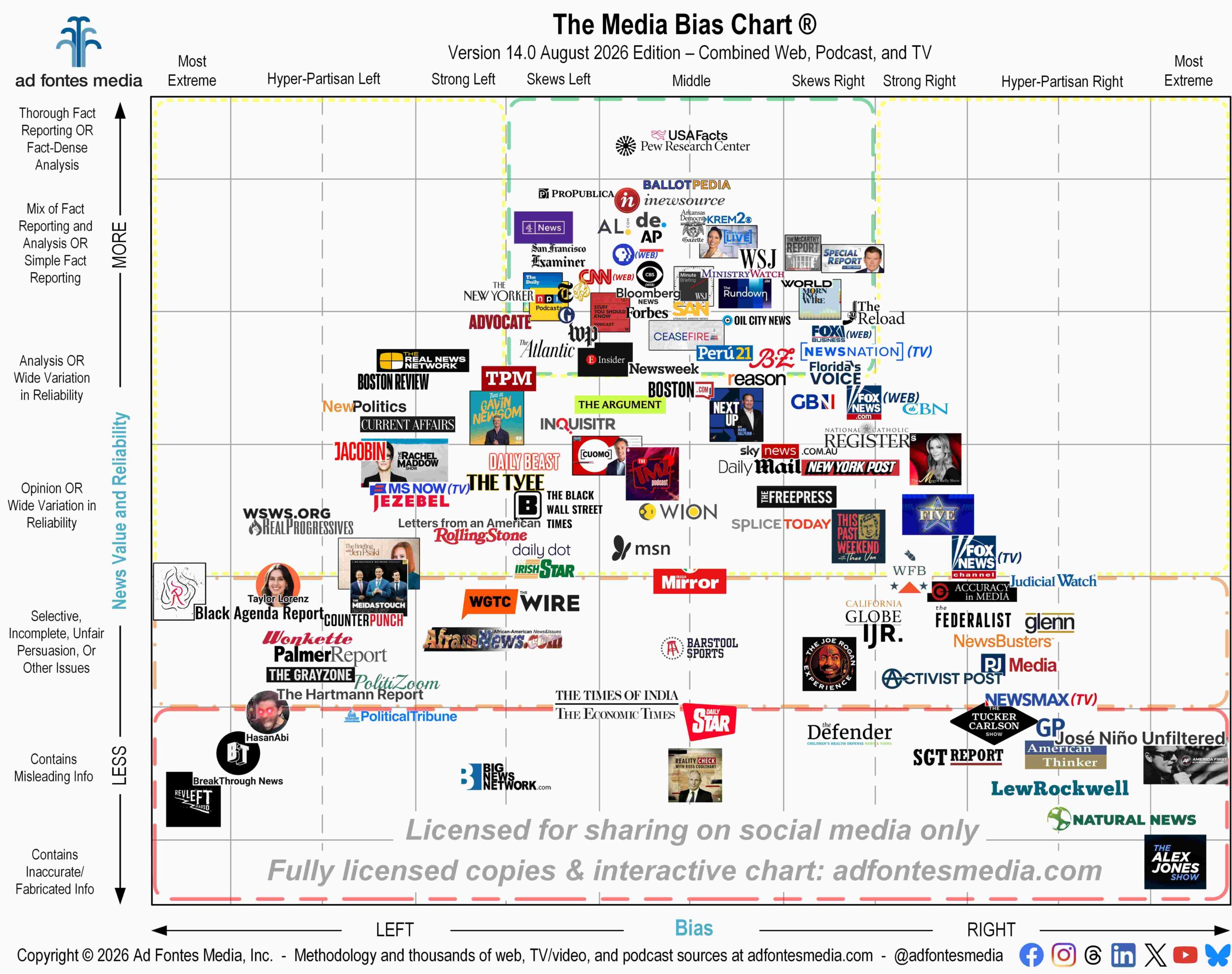
Jensen Huang resigned from the technology company Nvidia last week following reports of multiple extramarital affairs. Huang has admitted to having relationships with two employees and a woman who was suspected of spying for the Chinese government, although U.S. officials and lawmakers have differing levels of confidence in that suspicion. Our analysts rated media coverage in our Topic of the Week.
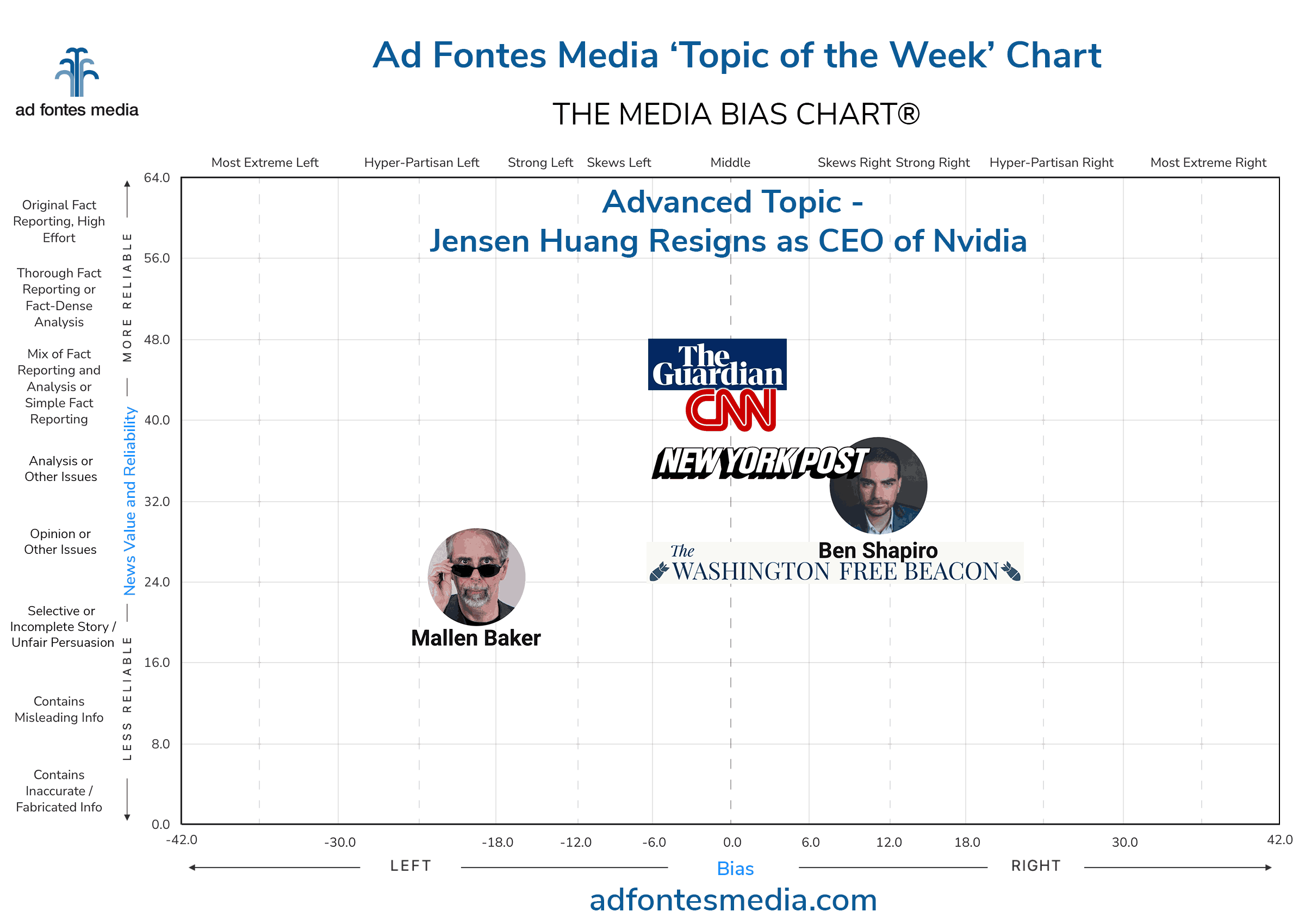
The Guardian
‘Jensen Huang lost his mind’: how AI’s smartest man fell for the world’s oldest trick
Bias: -1 (Middle)
Reliability: 45.33 (Mix of Fact Reporting and Analysis)
What was published: The article calls Huang’s relationship with a suspected spy “Silicon Valley’s worst nightmare come true” and “one of the most astonishing corporate scandals in memory.” The article describes Huang’s “downfall” and an example of the “constant theater of corporate espionage secretly playing out every day throughout the U.S.” It describes how the tech industry has been on the lookout for corporate espionage and calls Huang’s affair a “massive failure of corporate oversight.” The article gives the history of Silicon Valley as a prime target for foreign spying operations.
What our analysts said: The comprehensive article shines a light on espionage in U.S. companies. It is largely comprised of fact reporting, analysis and historical contextualization. The veracity is high, with quality context and sourcing.
CNN website
Jensen Huang resigned in disgrace from Nvidia. Many in Silicon Valley are still showering him with support
Bias: 0 (Middle)
Reliability: 41 (Simple Fact Reporting)
What was published: The article focuses on Silicon Valley colleagues and Nvidia former and current employees expressing support for Huang after his resignation. It includes quotes from many who praised Huang for his work, describing Nvidia as fostering “deep employee loyalty.” The article describes his influence “across the broader tech ecosystem.”
What our analysts said: The article is basic reporting about Huang’s work at Nvidia and his resignation. It includes only one negative opinion of Huang versus all the positive opinions of support; however, no political bias is present. A number of primary sources are quoted, but the reliability score is decreased slightly due to the omission of other contextual facts about the case.
New York Post
Jensen Huang eyeing comeback as Nvidia CEO forming ‘war room’ with allies in wake of Chinese spy, employee affairs
Bias: 2.33 (Middle)
Reliability: 35.67 (Analysis)
What was published: The article reports that Silicon Valley executives are lobbying for Huang’s return to Nvidia. It includes comments from Treasury Secretary Scott Bessent, who said Nvidia “needs to look outside the company for leadership” and blamed Commerce Secretary Howard Lutnick and his department for not better regulating exports to Megaspeed, the company accused of smuggling high-end Nvidia chips to China. Alice Huang, the suspected spy with whom Jensen Huang had an affair, was an executive at the Singapore-based company.
What our analysts said: The article is a fact-based analysis of the events following Huang’s resignation, with strongly corroborated facts, but some things were left out, such as potential national security implications of his relationship with a suspected Chinese intelligence operative. This results in a selectively composed article that reflects bias in support of Huang. The article has a sensationalistic tone, which lowers reliability.
Ben Shapiro (YouTube)
Ben Reacts To Jensen Huang Resignation
Bias: 11.33 (Skews Right)
Reliability: 32 (Analysis)
What was published: In the video, Shapiro expresses surprise that Huang resigned and thinks trying to replace him “could be the beginning of a gigantic mistake.” He talks about who might replace Huang long term, including former Apple CEO Tim Cook: “That would probably be their best pick,” he said, adding that Huang is difficult to replace because he succeeded at the company, with “some sort of ancillary scandal” forcing him out. Shapiro gives background on Huang’s affair and how it connects to chips sold to Megaspeed, which then sent the chips to China. It describes how the scandal affected Nvidia’s stock price “all solely because of Jensen Huang’s zipper problem.” He describes the situation as “a sex scandal combined with a corruption scandal combined with a spying scandal and all of that wrapped in the biggest AI company on planet Earth.” Shapiro believes that lawmakers should crack down on China for “trying so hard to cheat” to win the AI race but says when Democrats take control of the legislature next year, “it’s much more likely that they will be vindictive, that they’ll go after Nvidia’s business more broadly.”
What our analysts said: Shapiro is critical of the Democrats and speculates as to how they will operate with regards to the Nvidia scandal, leading to a bias score on the right. The article includes characterizations and opinions that lower veracity, such as unverified and speculative claims that Megaspeed was a Chinese front company and that it repackaged Nvidia chips and shipped them to China.
The Washington Free Beacon
To Nvidia and Beyond: Measuring the Extent of China’s Infiltration
Bias: 8 (Skews Right)
Reliability: 25.67 (Opinion)
What was published: Columnist Mike Watson writes that the Nvidia scandal is “a warning that America’s enemies are determined to infiltrate all levels of our society to subvert it.” He argues that the U.S. needs more defenses against foreign espionage. He describes the allegations against Alice Huang, including fears that she “skirted or outright violated American export controls to feed Chinese artificial intelligence companies.” Watson says Jensen Huang, who is an advisor to President Trump, was critical of U.S. government policy controlling exports to China, “and his infidelity raises troubling questions about his motivations for doing so.” He describes how China has tried to undermine the U.S. for decades, from acquiring trade secrets to propaganda campaigns to “seducing elites.” He says House Democrats want to “close or hobble the select committee on China once they assume the majority. This would be terribly shortsighted.”
What our analysts said: This article is historical analysis with opinion. Watson mixes some documented facts, incomplete investigative findings, and some suspicions that have not yet been proven. The reliability is decreased by the several large claims that are not sourced or given material context. The column has a right bias because it criticizes Democrats even before they take control of Congress.
Mallen Baker (YouTube)
Jensen Huang Scandal Breaks Trump’s AI Dream
Bias: -19.33 (Hyper-Partisan Left)
Reliability: 23.67 (Unfair persuasion)
What was published: Baker describes the AI industry as “the playground of a handful of individuals, most of whom have planted themselves firmly in Donald Trump’s orbit over the last two years and none of which seem to be … a stable, safe pair of hands that you might hope for.” He says because of his relationship with Huang, Trump sweeps allegations of misconduct under the rug: “Well, no worries. He’s a good guy. He’s donated to the ballroom amongst other things … and he takes calls with the president often late at night where he doubtless used to feed Trump’s ego and talk up the upside of the tech revolution.” Baker scolds Trump for ignoring warnings that Huang was having an affair with a suspected Chinese spy and describes Huang as “striding across the AI industry like a colossus dressed in his trademark black leather jacket.” He explains Huang’s various affairs and how he and other tech leaders “bet the farm on Donald Trump.” They didn’t want to miss out on the influence Elon Musk had, Baker says, “so they piled in, funding Trump’s vanity projects, flattering him, smiling warmly on, or at least turning a blind eye to his astonishing cryptocorruption schemes.” In return, they expected Trump to fend off regulation of the AI industry while they tried to “promote the value of artificial intelligence to the wider public and undermine so-called woke criticisms about the downside of it.” The overall goal was to beat China at AI, but they have failed, he says, as China appears to be catching up. He speculates that the scandals at Nvidia, one of the “companies with big ego unstable characters at their heart,” will “likely not be the catalyst that causes the much bigger AI bubble explosion” that investors have been fearing — at least, not right away. Still, he concludes, “It stands as a testament to the fragility of our time, where we are walking on eggshells and surrounded by big characters and juvenile standards of ethics and governance. They’re all stomping around in big, thick, heavy boots.”
What our analysts said: The host insults Donald Trump throughout the video, using sarcastic and sensationalist language, which led to the left bias score. His unsubstantiated claims, insults and sarcasm directed at the Trump administration colored the entire program. The video’s veracity is decreased by insults, speculation and predictions. The reliability score is lowered by the insults and selective characterizations of Huang, Trump and others.
Want to see if you agree with our ratings? Follow along with our weekly Topic of the Week exercise by visiting our website. New Topics of the Week are posted each Monday. Read the articles and watch the videos yourself, then come back on Wednesday to compare your scores with our analysts. Learn more here.
 Beth Heldebrandt is director of communications at Ad Fontes Media. She has more than 35 years of experience in the fields of journalism and public relations, and was an adjunct instructor of journalism for 17 years at Eastern Illinois University. Beth has a B.A. in journalism from Southern Illinois University-Carbondale and an M.A. in English from Eastern Illinois University. She’s a mom and grandma, and enjoys traveling, puzzles and reading.